
The world of robotics and wearable technology is fast growing, and exoskeletons and wearable robotics are among the most significant advancements in this industry. These innovative devices are intended to improve human strength, movement, and endurance, making duties easier for workers, assisting with medical rehabilitation, and even revolutionizing military operations. As AI, sensor technologies, and lightweight materials advance, exoskeletons become more effective and widely used across industries.
What Are Exoskeletons & Wearable Robotics?
Exoskeletons are wearable robotic devices that support, strengthen, and extend the human body’s capabilities. They can be powered (active) or non-powered (passive), depending on their purpose. Unlike traditional robots, which replace human labor, exoskeletons collaborate with humans to improve their innate abilities.
Wearable robotics, on the other hand, refers to small robotic devices embedded in garments, gloves, or body-worn suits. These are especially beneficial in healthcare, occupational safety, and mobility support, as they enable users to move more effectively and safely.
Types of Exoskeletons & Wearable Robotics
Medical & Rehabilitation Exoskeletons
One of the most promising uses for exoskeleton technology is in healthcare and rehabilitation. Patients with spinal cord injuries, strokes, or neurological problems can use these devices to regain mobility and independence.
- Powered lower-body exoskeletons can help paralyzed individuals walk again.
- Wearable robotic gloves help stroke sufferers with hand movement therapy.
- Elderly people can utilize lightweight exosuits to improve movement and prevent falls.
These technologies improve quality of life by allowing people to recover more quickly and regain lost bodily functions.
Military & Defense Exoskeletons
Exoskeletons are being developed for military use to improve soldier endurance and strength. These upgraded suits enable soldiers to carry more equipment, move faster, and lessen tiredness on long operations.
- Combat exoskeletons enhance physical performance on the battlefield.
- Load-bearing robotic suits allow soldiers to carry up to 200 pounds of equipment without strain.
- Exosuits for injury prevention protect soldiers from joint and muscular fatigue, lowering the risk of long-term damage.
Military exoskeletons that have been enhanced with AI may now give real-time analytics, terrain adaption, and automatic energy management.
Industrial & Workplace Exoskeletons
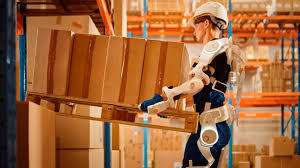
Wearable robotics are being adopted by the manufacturing and logistics industries to increase worker productivity and safety. These exosuits put less strain on the body, avoiding injuries caused by repetitive tasks and heavy lifting.
- Upper-body exoskeletons help to lift big goods with minimal effort.
- Back-support exosuits help to reduce occupational injuries in labor-intensive industries such as construction and warehouse operations.
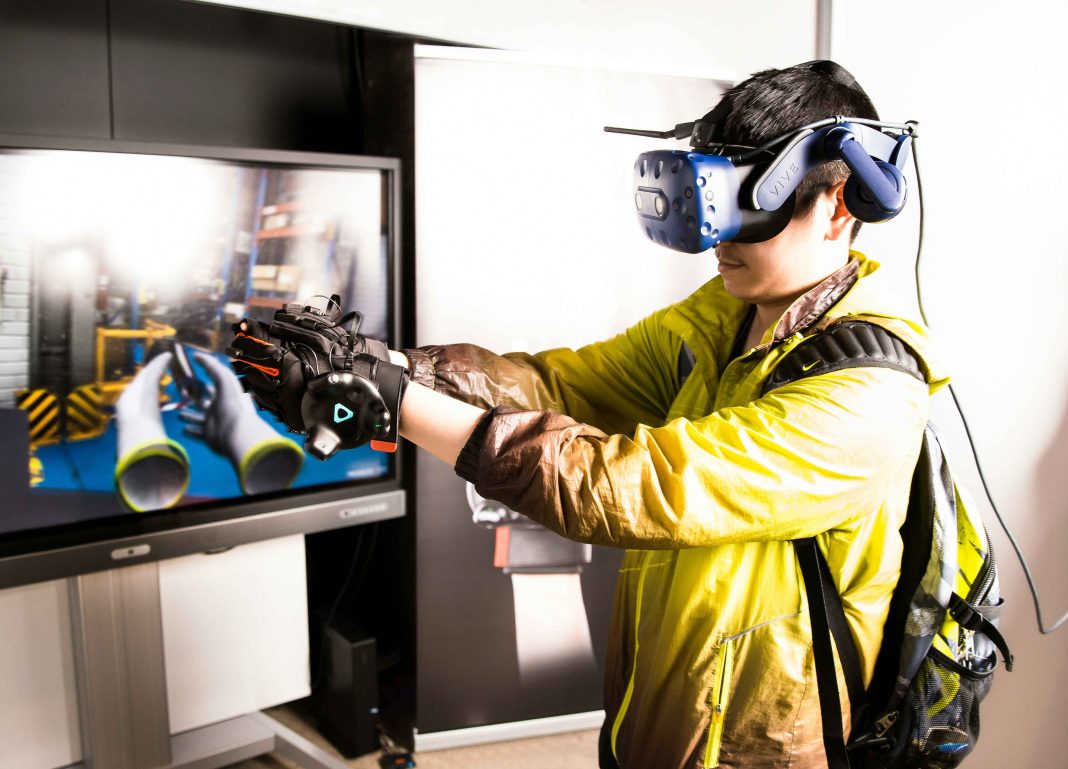
- Wearable robotic gloves give greater grip strength for jobs that require precision.
These exoskeletons adjust to individual workers’ motions using AI-powered motion tracking, offering tailored assistance and reducing tiredness.
How AI & Sensors Enhance Exoskeletons
Modern exoskeletons use artificial intelligence (AI), machine learning, and smart sensors to give real-time adaptive support. These technologies allow exoskeletons to:
- Automatically modify support levels based on predicted user movements.
- Monitor muscle activity to maximize energy efficiency and avoid strain.
- Adjust torque and resistance in response to real-time feedback.
- Communicate with wearable health monitoring to track your recovery progress.
As AI and sensor technology progress, future exoskeletons will become more intuitive, responding to brain impulses and physiological data for seamless integration with human movement.
Key Benefits of Exoskeletons & Wearable Robotics
- Enhanced Strength and Endurance – Users can carry larger objects, travel longer distances, and do jobs faster.
- Injury prevention lowers the risk of musculoskeletal problems and workplace injuries.
- Faster Rehabilitation – Assists patients in regaining mobility and independence following injuries.
- Increased Workplace Productivity – Helps with labor-intensive jobs, lowering weariness and enhancing efficiency.
- Military Advantage – Increases soldiers’ endurance, strength, and agility, making operations safer and more effective.
Challenges & The Future of Exoskeleton Technology
Despite their potential, exoskeletons and wearable robotics confront a number of problems, including high costs, limited battery life, and regulatory requirements. However, as technology progresses, these restrictions are being addressed.
- AI-powered adaptable exosuits that respond in real time to human needs.
- Soft robotics enables lightweight, flexible, and natural movement.
- Brain-controlled exoskeletons allow users to control movement with neural impulses.
- Augmented reality (AR) integration enables real-time control and navigation.
With these advancements, exoskeletons will become more inexpensive, efficient, and extensively used across industries.
Conclusion
Exoskeletons and wearable robotics are revolutionizing human enhancement by increasing strength, movement, and endurance. Wearable solutions are revolutionizing lives in healthcare, the military, and industry by making tasks safer, easier, and more efficient. As AI, machine learning, and material science improve, exoskeletons will become even more advanced, lightweight, and intelligent, empowering human capacities like never before.