
Introduction
You ask an AI chatbot a question, it gives you a confident, detailed answer, and later you find out the answer was completely wrong, sometimes citing a source that doesn’t even exist. This isn’t a rare glitch; it’s a well-known behavior called “hallucination,” and understanding why it happens makes it much easier to use AI tools without getting burned by them.
What “Hallucination” Actually Means
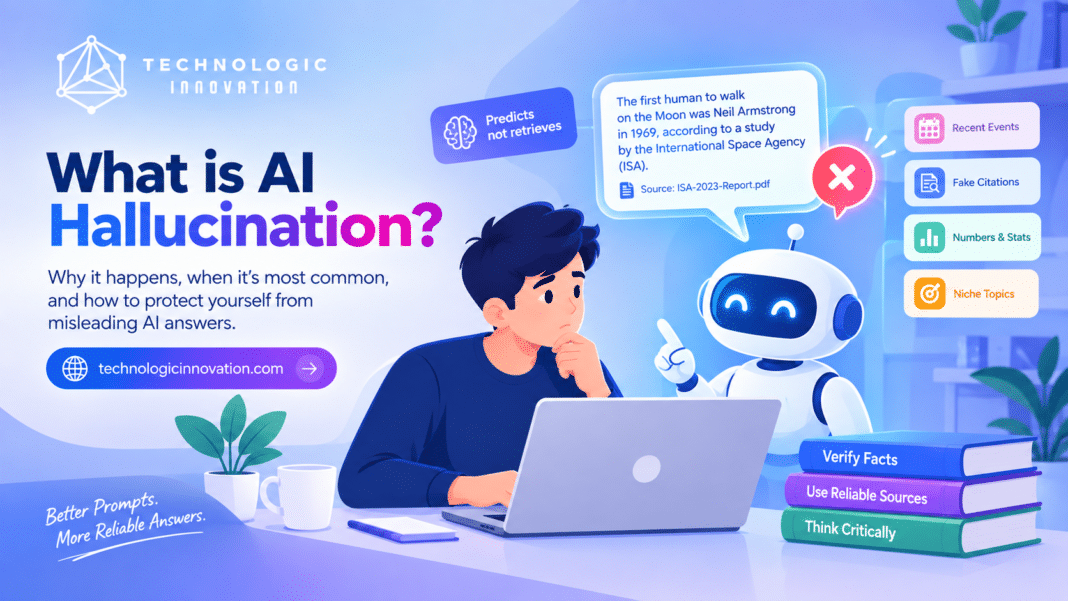
In AI terminology, a hallucination is when a chatbot generates information that sounds plausible and confident but is factually incorrect or entirely made up. This isn’t the AI “lying” in any intentional sense; it’s a byproduct of how these systems are fundamentally built to generate responses.
Why This Happens: The Simple Explanation
AI chatbots don’t actually “know” facts the way a database does. Instead, they predict what word is statistically most likely to come next based on patterns learned from massive amounts of text during training. Most of the time, this produces accurate, useful answers, because factual information tends to appear consistently across the text the model learned from. But when a question touches on something obscure, recent, or where the model’s training data was thin or contradictory, it still generates a confident-sounding answer, because generating a plausible-sounding response is what it’s built to do, whether or not that response is actually true.
When Hallucinations Happen Most Often
Niche or highly specific topics: Questions about obscure facts, small companies, or specific technical details are more likely to produce made-up answers, since the model has less reliable training data to draw from.
Recent events: AI models have a training cutoff date, and questions about anything after that point can result in outdated or entirely fabricated information, unless the tool has live search capability built in.
Citations and sources: Chatbots asked to provide a specific source, study, or quote will sometimes generate a citation that sounds completely legitimate but doesn’t actually exist, since it’s predicting what a citation typically looks like rather than retrieving a real one.
Numbers and statistics: Specific figures, dates, or statistics are a common area for confident-sounding but incorrect answers, since exact numbers are harder for the model to reliably reproduce than general concepts.
Complex, multi-step reasoning: Longer chains of reasoning give more opportunities for a small error early on to compound into a confidently wrong final answer.
Why This Isn’t Just a “Bug to Be Fixed”
It’s worth understanding that hallucination isn’t simply a software bug that will eventually be patched out completely. It’s a structural characteristic of how these models generate text in the first place. Newer models have gotten meaningfully better at reducing hallucination rates, and some now have access to live web search to verify claims in real time, but the underlying tendency to generate plausible-sounding text, whether or not it’s accurate, remains part of how these systems fundamentally work.
How to Protect Yourself From Being Misled
Verify anything specific and important: Facts, statistics, quotes, or citations that matter for a decision should be checked against an independent source before you rely on them.
Be more cautious with niche or recent topics: The more obscure or time-sensitive your question, the more skeptical you should be of a confident-sounding answer.
Ask the AI to cite where information comes from: While this doesn’t guarantee accuracy, and citations themselves can occasionally be fabricated, asking for sources at least gives you something concrete to verify against.
Use tools with live search when accuracy matters: AI tools built around search with visible citations, rather than relying purely on internal training data, tend to be more reliable for fact-checking specific claims.
Notice suspiciously confident specificity: An oddly precise number or an extremely detailed answer to a genuinely obscure question is worth extra scrutiny, since real uncertainty often gets glossed over with false confidence.
Why AI Sounds So Confident Even When It’s Wrong
One of the more frustrating aspects of hallucination is that AI models generally don’t express uncertainty the way a knowledgeable person naturally would when they’re unsure. Instead of saying “I’m not entirely sure,” they often generate an answer with the same confident tone regardless of whether the underlying information is solid or fabricated, which makes hallucinated answers harder to spot just from how they’re phrased.
Conclusion
AI chatbots making things up isn’t a rare malfunction; it’s a predictable behavior rooted in how these systems generate text by predicting likely-sounding patterns rather than retrieving verified facts. Understanding when hallucinations are more likely-niche topics, recent events, specific citations, and numbers- helps you know when to double-check an answer rather than taking confident-sounding AI output at face value. Treating AI responses as a helpful starting point rather than a verified fact, especially for anything important, remains the most reliable way to use these tools well.
Related Reading
- How to Write Better ChatGPT Prompts (A Simple Guide)
- Top Landing Page Builders for Marketing (2026 Guide)
FAQs
Q:01. What is AI hallucination? It’s when an AI chatbot generates information that sounds confident and plausible but is factually incorrect or entirely made up, rather than intentionally lying.
Q:02. Why do AI chatbots make up fake citations? Because they predict what a citation typically looks like based on patterns rather than retrieving an actual verified source, they can generate references that sound real but don’t exist.
Q:03. Can AI hallucination be completely fixed? Not entirely with current technology, since it’s rooted in how these models generate text. Newer models have reduced hallucination rates and some use live search for verification, but the underlying tendency remains.
Q:04. Which topics are most likely to trigger AI hallucinations? Niche or obscure subjects, recent events after the model’s training cutoff, specific numbers and statistics, and requests for exact citations are all common trigger points.
Q:05. How can I tell if an AI’s answer might be hallucinated? Be extra cautious with unusually specific details on obscure topics, always verify facts that matter for real decisions, and prefer AI tools with visible source citations when accuracy is important.