
Introduction
As AI writing tools have become common, so has the anxiety around getting flagged for using them, whether you’re a student worried about a false accusation, a teacher trying to verify original work, or a content creator wanting to check your own writing before publishing. AI detection tools promise to solve this, but how reliable are they really? Here’s an honest look at how these tools work and where they fall short.
How AI Detectors Actually Work
Most AI detection tools analyze patterns in writing that tend to differ between human and AI-generated text, such as sentence-structure predictability, word-choice variety, and how consistently certain phrasing patterns appear. The tool assigns a probability score estimating how likely the text is to be AI-generated, rather than giving a definitive yes-or-no answer.
This probabilistic approach is important to understand upfront: no AI detector can prove with certainty that a piece of text was or wasn’t written by AI. They’re estimating likelihood based on patterns, not scanning some hidden signature left by AI tools.
Why AI Detectors Are Genuinely Unreliable
False positives happen regularly. Human writing that happens to be very clear, structured, or simple can sometimes get flagged as AI-generated, particularly affecting non-native English speakers whose writing patterns may differ from what the detector was trained to recognize as “typically human.”
False negatives are just as common. Text that’s been lightly edited after being AI-generated, or generated by a newer AI model the detector wasn’t trained to recognize, can easily slip through undetected.
Detectors struggle to keep up with AI improvements. As AI writing models improve and produce more naturally varied text, detection tools trained on older AI patterns become less accurate over time, creating a constant game of catch-up.
No independent verification standard exists. Unlike, say, a blood test with an established accuracy rate, AI detectors don’t have a universally agreed-upon standard for measuring their own reliability, and different tools can give wildly different results on the exact same text.
What We Found Testing Popular Detectors
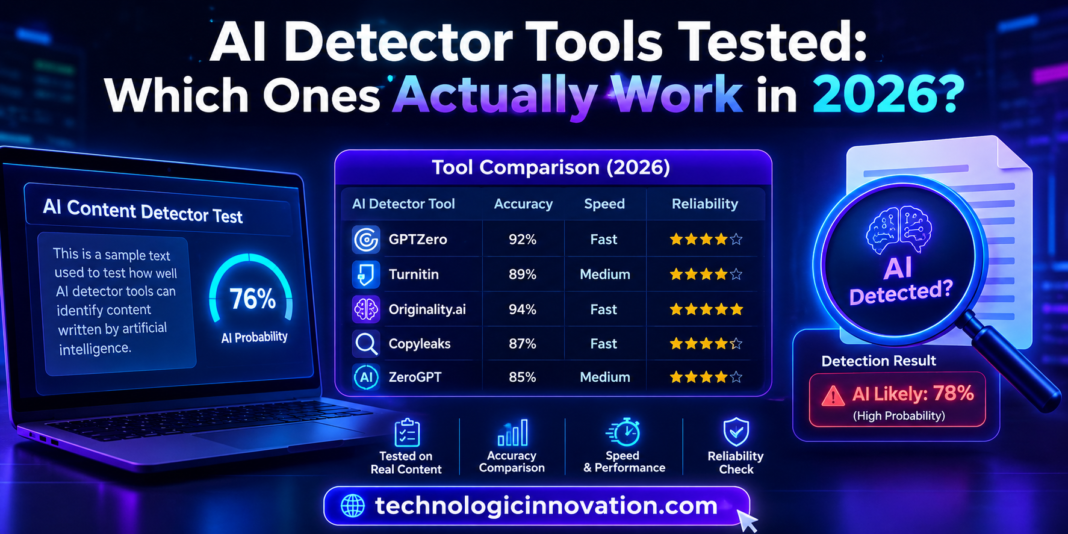
Consistency issues across tools: Running the same piece of text through multiple detection tools often produces different scores, sometimes dramatically different, which itself is a strong signal that none of these tools should be treated as a definitive answer.
Better at flagging obvious cases: Detectors tend to perform reasonably well on completely unedited, directly copy-pasted AI output. Their accuracy drops significantly once that text has been edited, paraphrased, or blended with human writing.
Longer text tends to score more reliably than short text. Short passages simply don’t give these tools enough pattern data to work with, making detection on brief text especially unreliable.
What AI Detectors Are Actually Useful For
Despite their limitations, these tools aren’t completely without value. They can work reasonably well as a first-pass screening tool for identifying text that’s worth a closer, more careful human review, rather than as a final verdict on their own. Some tools also do a decent job of flagging completely unedited AI output submitted with no modification at all, which remains a common way people get caught not because the detector is highly accurate, but because the case is obvious.
What This Means for Different Users
For students: If your school uses AI detection software, understand that these tools can produce false positives, especially if your writing style is naturally structured or simple. If flagged, being able to show your drafting process (notes, outline, revision history) can help demonstrate your work is genuinely your own.
For teachers and educators: Treating a high AI-detection score as definitive proof of cheating, rather than one data point worth discussing with a student, risks real false accusations given how unreliable these tools are.
For content creators and writers: Running your own writing through a detector before publishing can occasionally flag concerns, but a “high AI score” on genuinely human-written work isn’t unusual and doesn’t necessarily mean anything is wrong with your writing.
For businesses screening content, relying solely on an AI detector score to accept or reject freelance writing is risky given the false positive and negative rates; combining detection scores with other quality signals produces more reliable results.
The Bigger Picture
The reality is that reliably distinguishing AI-generated text from human writing, especially once that text has been edited, remains a genuinely unsolved technical problem. Detection tools provide a useful signal, not a verdict, and treating them as more accurate than they actually are creates real risk, whether that’s falsely accusing a student or businesses over-relying on an unreliable screening method.
Conclusion
AI detection tools can offer a useful starting signal, but none of them are accurate enough to serve as definitive proof of whether text was AI-generated, especially once that text has been edited or lightly rewritten. Understanding this limitation matters for anyone relying on these tools, whether you’re a student worried about false accusations, an educator trying to verify original work, or a business screening content; treating detection scores as one data point rather than a final verdict is the more reasonable approach given how these tools actually perform.
Related Reading
- Best AI Coding Assistants in 2026: GitHub Copilot vs Claude Code vs Cursor
- ChatGPT vs Other AI Tools: Which One Is Better for Content Creation?
FAQs
Q:01. Can AI detectors prove text was written by AI? No, they estimate a probability based on writing patterns, not a definitive proof. No current AI detection tool can guarantee certainty about whether text is AI-generated.
Q:02. Why do AI detectors sometimes flag human writing as AI-generated? Very clear, structured, or simple writing can share patterns with AI-generated text, leading to false positives, which particularly affects non-native English speakers.
Q:03. Do AI detectors work well on edited AI-generated text? Not reliably. Once AI-generated text is edited, paraphrased, or blended with human writing, detection accuracy drops significantly.
Q:04. Should schools rely on AI detectors to prove academic dishonesty? Given the real risk of false positives, most experts recommend treating a high detection score as a starting point for discussion rather than definitive proof of cheating.
Q:05. Are longer pieces of text easier for AI detectors to analyze? Yes, longer text gives detection tools more pattern data to work with, generally making results somewhat more reliable than very short passages.