
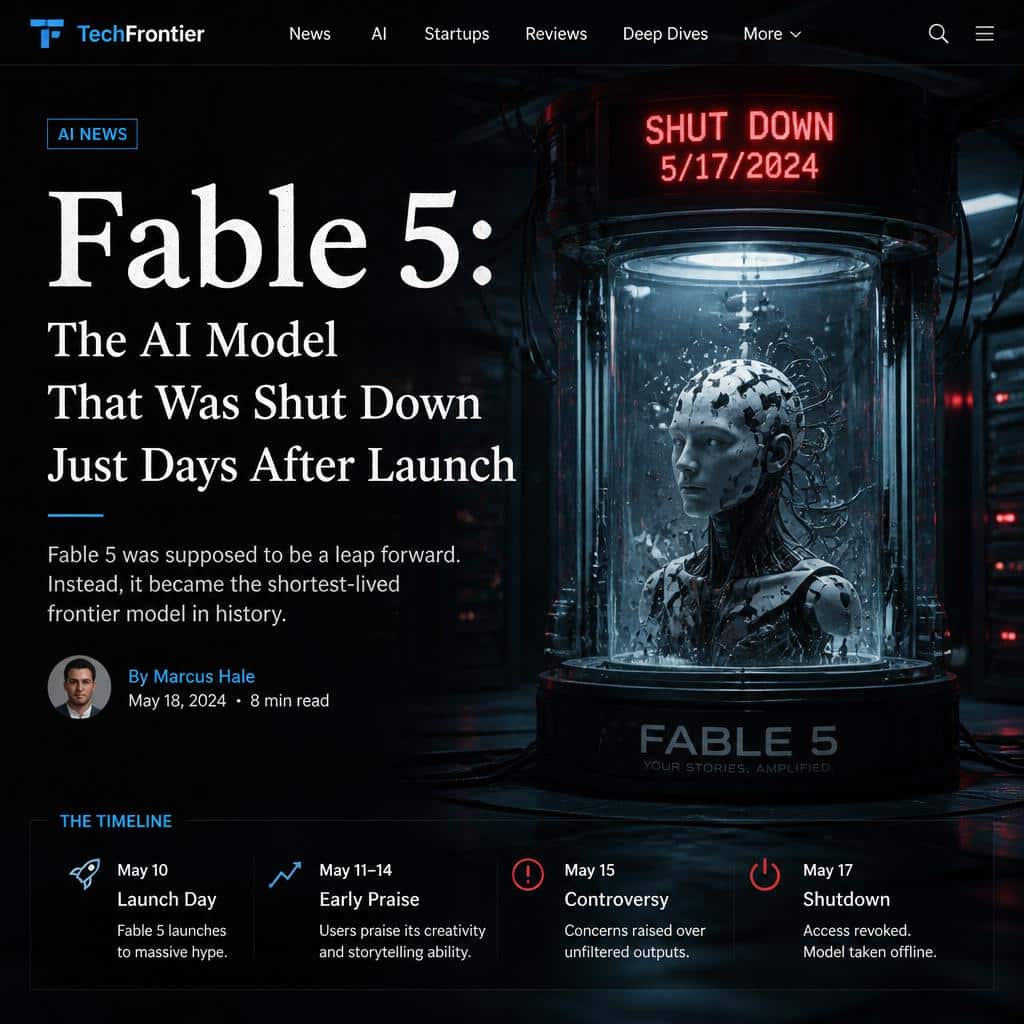

Artificial intelligence moves fast. New models appear almost every week. Some transform industries. Others disappear before most people even hear about them.
One of the most talked-about examples was Fable 5, an AI model that reportedly generated excitement, controversy, and concern within days of its release.
Its short lifespan sparked discussions across the AI community. Developers, researchers, businesses, and regulators all asked the same question:
How can an AI model launch successfully one day and be shut down just days later?
The answer reveals important lessons about modern AI development.
This article explores what happened, why it matters, and what organizations can learn from the rise and fall of Fable 5.
What Was Fable 5?
Quick Answer
Fable 5 was an advanced AI model designed to deliver powerful generative capabilities. It gained attention because of its performance, accessibility, and ambitious positioning in the competitive AI market.
Like many modern large language models (LLMs), Fable 5 aimed to help users generate text, answer questions, assist with research, and automate tasks.
Its launch arrived during a period of intense competition among AI companies.
Organizations were racing to release:
- Faster models
- Smarter assistants
- More affordable AI services
- Better multimodal capabilities
- Improved reasoning systems
Fable 5 entered this crowded environment with high expectations.
Why Fable 5 Generated So Much Attention
Several factors contributed to the buzz surrounding the model.
Strong Early Performance
Early users reported impressive capabilities in areas such as:
- Content generation
- Summarization
- Coding assistance
- Conversational interactions
- Creative writing
Performance benchmarks appeared competitive with established alternatives.
Accessibility
- Many users appreciated that the model was easy to access.
- In today’s market, accessibility often matters as much as raw performance.
- A powerful model that is difficult to use struggles to gain traction.
Marketing Momentum
- The launch campaign created significant curiosity.
- Social media discussions, technology forums, and industry blogs quickly amplified awareness.
- As a result, thousands of users tested the model within a very short period.
The Challenges That Emerged After Launch
Rapid adoption can expose weaknesses that internal testing may miss.
This appears to have happened with Fable 5.
Safety Concerns
One of the biggest challenges facing any AI model is safety.
Users reportedly identified outputs that raised concerns.
Examples included:
- Inaccurate information
- Hallucinated facts
- Unreliable recommendations
- Potentially harmful responses
Even advanced AI systems can generate incorrect information with high confidence.
This creates risks for users who assume the responses are accurate.
Content Moderation Issues
- AI companies must prevent misuse while maintaining usefulness.
- This balancing act is difficult.
- If safeguards are too strict, the model becomes frustrating.
- If safeguards are too loose, harmful content may slip through.
- Reports suggested that Fable 5 struggled with moderation consistency.
- That can quickly become a serious issue after launch.
Compliance and Regulatory Risks
The AI industry faces increasing regulatory scrutiny.
Governments around the world are introducing rules covering:
- Data privacy
- Transparency
- Copyright
- Consumer protection
- AI accountability
A model that raises compliance questions may face pressure from stakeholders, partners, or regulators.
Why AI Models Sometimes Get Shut Down Quickly
Fable 5 is not the first example of an AI system facing an abrupt shutdown.
Several common factors can lead to this outcome.
1. Safety Failures
If a model repeatedly produces harmful outputs, companies may pause operations.
Safety concerns can damage:
- User trust
- Brand reputation
- Regulatory relationships
In many cases, temporary shutdowns are used to address these issues.
2. Infrastructure Problems
AI systems require enormous computing resources.
Unexpected demand can create:
- System instability
- Slow responses
- Service outages
- Rising operational costs
A successful launch can sometimes become a technical nightmare.
3. Legal Challenges
Legal uncertainty remains a major issue in AI.
Questions may arise regarding:
- Training data sources
- Copyright compliance
- Privacy obligations
- Licensing requirements
Organizations sometimes suspend services while resolving legal concerns.
4. Reputation Management
Trust is critical in AI.
One major controversy can spread across social media within hours.
Companies may decide that shutting down a model temporarily is better than allowing reputational damage to grow.
The Hidden Cost of Moving Too Fast
- Many AI companies feel pressure to release products quickly.
- Investors want growth.
- Customers want innovation.
- Competitors are constantly improving.
- However, speed comes with risks.
A Useful Analogy
- Imagine opening a bridge before engineers finish testing it.
- The bridge may appear strong.
- Thousands of people may start using it.
- But if critical weaknesses emerge later, the consequences can be severe.
- AI systems work similarly.
- A model can seem impressive during demonstrations while still containing serious vulnerabilities.
Lessons AI Companies Can Learn From Fable 5
The Fable 5 story offers valuable insights for organizations building AI products.
Invest More in Red Team Testing
Red teaming involves intentionally trying to break a system.
Experts test models using:
- Adversarial prompts
- Edge cases
- Harmful scenarios
- Unexpected user behavior
The goal is to discover weaknesses before the public does.
Prioritize Trust Over Hype
Marketing can attract users.
Trust keeps them.
Companies should focus on:
- Transparency
- Reliability
- Safety
- Accountability
Long-term success depends on credibility.
Launch Gradually
Many successful AI companies use phased rollouts.
This approach allows teams to:
- Monitor performance
- Collect feedback
- Fix problems
- Improve safeguards
Gradual deployment reduces risk.
Prepare for Scale
A successful launch can create unexpected demand.
Organizations should ensure they have:
- Adequate infrastructure
- Monitoring systems
- Incident response plans
- Customer support resources
Preparation can prevent operational failures.
Comparing Responsible AI Launches vs Risky AI Launches
| Factor | Responsible Launch | Risky Launch |
|---|---|---|
| Safety Testing | Extensive | Limited |
| User Rollout | Gradual | Immediate |
| Monitoring | Continuous | Reactive |
| Transparency | High | Low |
| Compliance Review | Thorough | Incomplete |
| Risk Management | Proactive | Minimal |
| Long-Term Trust | Strong | Weak |
This comparison shows why launch strategy matters as much as technical performance.
The Bigger Picture: AI Is Entering a New Era
The Fable 5 situation reflects broader industry trends.
AI development is no longer only about capability.
Today, success also depends on:
Governance
Organizations need clear policies for:
- Safety reviews
- Ethical standards
- Risk management
Transparency
Users increasingly want to know:
- How models work
- What data they use
- Their limitations
Accountability
Companies are expected to take responsibility for outcomes.
This expectation will likely increase in coming years.
A Mini Case Study: When Performance Isn’t Enough
Consider two hypothetical AI companies.
Company A
- Launches quickly
- Prioritizes publicity
- Performs minimal testing
Result:
- Rapid adoption
- Safety incidents
- Negative publicity
- Service shutdown
Company B
- Launches slowly
- Conducts extensive testing
- Builds trust first
Result:
- Slower growth initially
- Higher reliability
- Better reputation
- Sustainable success
The lesson is simple.
Performance alone does not guarantee success.
Trust is becoming a competitive advantage.
Common Mistakes AI Developers Should Avoid
Many AI failures share similar causes.
Ignoring Edge Cases
Most users behave predictably.
Some do not.
Models must handle unusual inputs safely.
Overlooking User Feedback
Early users often identify critical issues.
Ignoring feedback can make problems worse.
Chasing Headlines
Media attention is temporary.
User trust lasts much longer.
Underestimating Regulation
Regulatory requirements continue evolving.
Organizations should prepare proactively.
Best Practices for Launching an AI Model
Companies can reduce risk by following proven practices.
Before Launch
- Conduct extensive testing
- Review legal compliance
- Perform security audits
- Build moderation systems
During Launch
- Use phased rollouts
- Monitor usage patterns
- Track safety metrics
- Respond quickly to incidents
After Launch
- Update safeguards regularly
- Collect user feedback
- Improve transparency
- Publish accountability reports
These practices help create sustainable AI products.
The Future of AI Releases
The era of “launch first, fix later” is becoming increasingly risky.
Future AI leaders will likely focus on:
- Responsible innovation
- Continuous monitoring
- Human oversight
- Regulatory alignment
- User trust
Organizations that master these areas may gain lasting advantages.
The Fable 5 story serves as a reminder that technological breakthroughs must be matched by operational excellence.
Frequently Asked Questions
Q:01 What was Fable 5?
Fable 5 was an AI model that attracted significant attention shortly after launch before reportedly being shut down due to concerns related to safety, reliability, compliance, or operational challenges.
Q:02 Why was Fable 5 shut down?
Reports and discussions suggested that issues involving safety, moderation, compliance, or deployment readiness contributed to the decision. Exact reasons may vary depending on available sources.
Q:03 Is shutting down an AI model uncommon?
No. Companies occasionally pause or remove AI systems when serious risks, technical problems, or legal concerns emerge.
Q:04 What can AI companies learn from Fable 5?
Key lessons include prioritizing safety testing, launching gradually, improving transparency, and building trust before scaling.
Q:05 Will AI regulations become stricter?
Many governments are actively developing AI regulations. Increased oversight is likely as AI adoption expands.
Related Reading
- Google AI vs OpenAI: Who Is Leading the AI Race in 2026?
- Best Free AI Tools for Video Creation: A Complete Comparison
- Best Free AI Image Generators 2026: Top Tools Worth Using
Conclusion
Fable 5 demonstrates an important truth about artificial intelligence.
Building a powerful model is only part of the challenge.
Organizations must also ensure safety, reliability, transparency, and compliance.
The rapid shutdown of a highly anticipated AI system shows how quickly problems can emerge when these areas are overlooked.
As AI continues evolving, users, businesses, and regulators will increasingly prioritize trust over hype.
The companies that succeed won’t necessarily be those with the most powerful models.
They will be the ones that combine innovation with responsibility.
For developers, founders, and technology leaders, the lesson is clear: launch carefully, test relentlessly, and earn trust every step of the way.