
Introduction
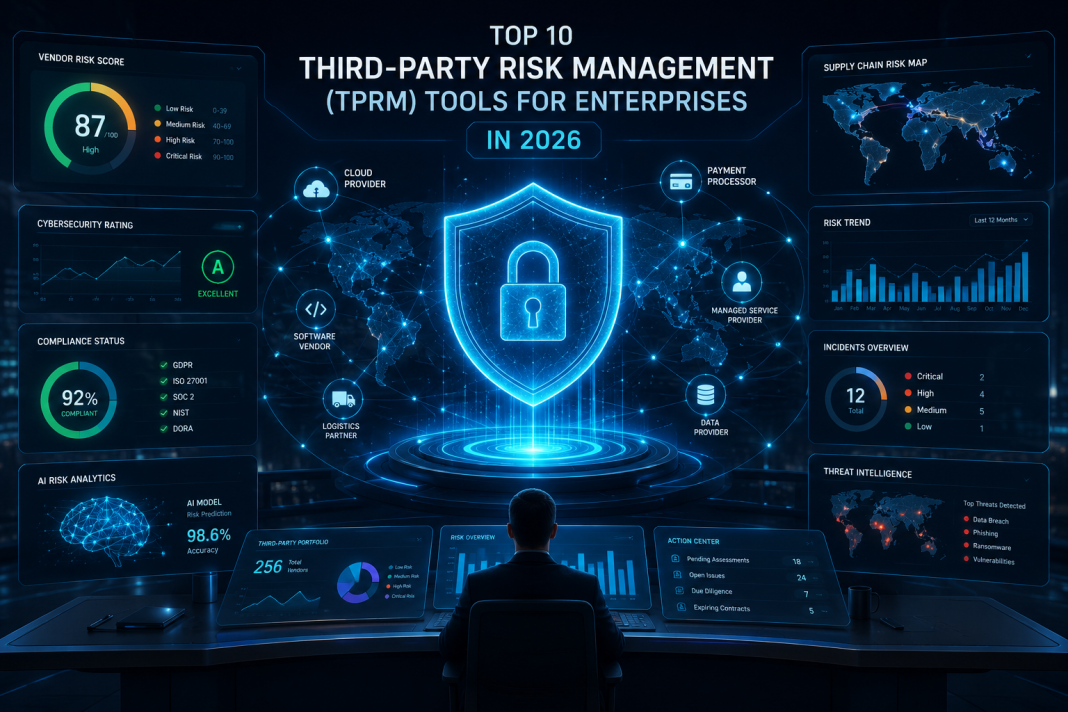
Third-party risk is no longer a back-office problem. It is now a board-level security concern for enterprises worldwide.
In 2026, companies rely on thousands of vendors, cloud services, APIs, and outsourcing partners. Every connection increases exposure. A single weak vendor can trigger a data breach, compliance failure, or operational shutdown.
This is why organizations now invest heavily in Third-Party Risk Management (TPRM) tools.
A modern TPRM platform helps companies:
- Identify vendor risks early
- Monitor cybersecurity posture continuously
- Automate compliance and audits
- Reduce manual questionnaire overload
- Strengthen supply chain security
In this guide, you will learn the top 10 TPRM tools for enterprises in 2026, their strengths, use cases, and how to choose the right one.
What is Third-Party Risk Management (TPRM)?
Third-Party Risk Management (TPRM) is the process of identifying, assessing, and controlling risks introduced by external vendors and partners.
These risks may include:
- Cybersecurity vulnerabilities
- Data privacy violations
- Regulatory non-compliance
- Operational disruptions
- Financial instability
Modern enterprises use TPRM tools to replace manual spreadsheets with automated, continuous risk intelligence systems.
Why TPRM Tools Matter in 2026
TPRM has become essential because:
1. Supply chains are more digital than ever
Companies depend heavily on SaaS tools and cloud vendors.
2. Cyberattacks target vendors first
Attackers often exploit weaker third-party systems to reach enterprise networks.
3. Regulations are tightening
Frameworks like DORA, NIS2, ISO 27001, and SOC 2 require continuous vendor oversight.
4. Manual assessments don’t scale
Enterprises can’t manage thousands of vendors using spreadsheets.
Key Features of Modern TPRM Tools
Before choosing a platform, enterprises should look for:
- Continuous vendor monitoring
- AI-powered risk scoring
- Automated questionnaires
- Compliance mapping (ISO, NIST, SOC2)
- Integration with GRC tools (ServiceNow, Archer)
- Fourth-party risk visibility
- Real-time alerts and dashboards
1. Bitsight (Best for Cyber Risk Intelligence)
Bitsight is one of the most advanced TPRM platforms focused on external cyber risk monitoring.
Key Strengths:
- Continuous monitoring of millions of organizations
- AI-driven risk scoring and analytics
- Dark web and threat intelligence integration
- Regulatory mapping (NIST, DORA, ISO)
- Strong board-level reporting
Best For:
Large enterprises and financial institutions needing real-time cyber risk visibility
Limitation:
Less focused on internal workflow customization compared to pure GRC tools.
2. SecurityScorecard (Best for Security Ratings)
SecurityScorecard provides letter-grade security ratings (A–F) for vendors.
Key Strengths:
- External attack surface scoring
- Continuous vendor monitoring
- Large global vendor database
- Simple risk visualization
Best For:
Companies wanting fast vendor benchmarking
3. OneTrust (Best for Full GRC Ecosystem)
OneTrust is a broad governance and privacy platform with a strong TPRM module.
Key Strengths:
- End-to-end GRC platform
- Vendor onboarding workflows
- Automated compliance mapping
- Privacy + ESG + risk integration
Best For:
Enterprises needing unified governance and compliance system
4. ProcessUnity (Best for Workflow Automation)
ProcessUnity focuses on structured vendor risk workflows.
Key Strengths:
- Strong assessment automation
- Custom risk scoring models
- Vendor lifecycle tracking
- Enterprise workflow design
Best For:
Organizations with mature GRC teams needing custom workflows
5. RSA Archer (Best for Enterprise GRC Integration)
RSA Archer is widely used in large enterprises.
Key Strengths:
- Highly configurable risk framework
- Deep compliance reporting
- Integration with enterprise systems
- Strong audit capabilities
Best For:
Large enterprises already using Archer for risk management
6. Venminder (Best for Vendor Onboarding)
Venminder specializes in vendor lifecycle management.
Key Strengths:
- Vendor onboarding support
- Document collection automation
- Managed assessment services
- Easy-to-use interface
Best For:
Teams with limited risk staff
7. UpGuard (Best End-to-End TPRM Lifecycle)
UpGuard offers full lifecycle vendor risk management.
Key Strengths:
- Vendor onboarding + offboarding
- Continuous monitoring
- Security questionnaire automation
- Cyber risk ratings
Best For:
Mid-to-large enterprises wanting end-to-end simplicity
8. RiskRecon (Best for External Cyber Visibility)
RiskRecon focuses on external security posture.
Key Strengths:
- Clear risk scoring model
- Minimal noise in alerts
- External attack surface analysis
- Easy integration into GRC tools
Best For:
Teams focused on clean, external risk signals
9. Prevalent (Best for Managed Services + TPRM)
Prevalent combines software + managed services.
Key Strengths:
- Questionnaire automation
- Vendor risk intelligence
- Managed TPRM support team
- Continuous monitoring
Best For:
Organizations with lean internal security teams
10. Black Kite (Best for Supply Chain Risk Intelligence)
Black Kite specializes in supply chain cyber risk visibility.
Key Strengths:
- Cyber risk quantification
- Vendor breach prediction
- Supply chain mapping
- Incident tracking intelligence
Best For:
Enterprises concerned with systemic supply chain risk
Comparison Table of Top TPRM Tools (2026)
| Tool | Strength | Best For |
|---|---|---|
| Bitsight | Cyber intelligence + monitoring | Large enterprises |
| SecurityScorecard | Security ratings | Quick vendor scoring |
| OneTrust | Full GRC suite | Enterprise governance |
| ProcessUnity | Workflow automation | Compliance-heavy orgs |
| Archer | Enterprise risk system | Large regulated firms |
| Venminder | Vendor onboarding | Small security teams |
| UpGuard | End-to-end TPRM | Scalable programs |
| RiskRecon | External visibility | Cyber-focused teams |
| Prevalent | Managed services | Lean teams |
| Black Kite | Supply chain intelligence | Advanced risk modeling |
How to Choose the Right TPRM Tool
Step 1: Define your primary goal
- Cyber risk visibility → Bitsight, SecurityScorecard
- Workflow automation → ProcessUnity, Archer
- All-in-one GRC → OneTrust
Step 2: Check vendor size
- Small team → Venminder, Prevalent
- Enterprise → Bitsight, Archer
Step 3: Evaluate integrations
Look for compatibility with:
- ServiceNow
- SAP
- Okta
- Jira
Step 4: Decide monitoring depth
- Continuous monitoring → Bitsight, RiskRecon
- Questionnaire-heavy → ProcessUnity
Common Mistakes Enterprises Make
- Relying only on questionnaires
- Ignoring fourth-party risk
- Using too many disconnected tools
- Treating TPRM as annual compliance task
- Not automating vendor onboarding
Expert Insight (2026 Trend)
The biggest shift in 2026 TPRM is the move toward:
“Continuous, AI-driven risk intelligence instead of static assessments.”
Platforms are no longer just tracking vendors—they are predicting risk before incidents happen.
FAQ
Q:01 What is the best TPRM tool in 2026?
Bitsight is widely considered the strongest enterprise TPRM platform due to its continuous monitoring and cyber risk intelligence.
Q:02 What does a TPRM tool do?
It identifies, assesses, and monitors risks from third-party vendors across cybersecurity, compliance, and operations.
Q:03 Why is TPRM important for enterprises?
Because vendors are now a major source of data breaches and regulatory failures in modern supply chains.
Q:04 Which TPRM tool is easiest to use?
Venminder and UpGuard are often considered more user-friendly for smaller teams.
Q:05 What is the difference between TPRM and GRC?
TPRM focuses on vendor risk, while GRC covers overall governance, risk, and compliance.
Related Reading
- Best Free AI Tools for Video Creation: A Complete Comparison
- Best Free AI Image Generators 2026: Top Tools Worth Using
- Best AI Tools for Email Writing in 2026
Conclusion
Third-party risk management is now a critical part of enterprise cybersecurity strategy.
In 2026, the best TPRM tools combine:
- AI automation
- Continuous monitoring
- Compliance intelligence
- Supply chain visibility
Whether your goal is deep cyber intelligence (Bitsight) or workflow automation (ProcessUnity, Archer), the right tool depends on your organization’s risk maturity.
One thing is clear:
manual vendor risk management is no longer enough.
Enterprises that invest in modern TPRM platforms will be far better positioned to prevent breaches, ensure compliance, and protect their supply chains.