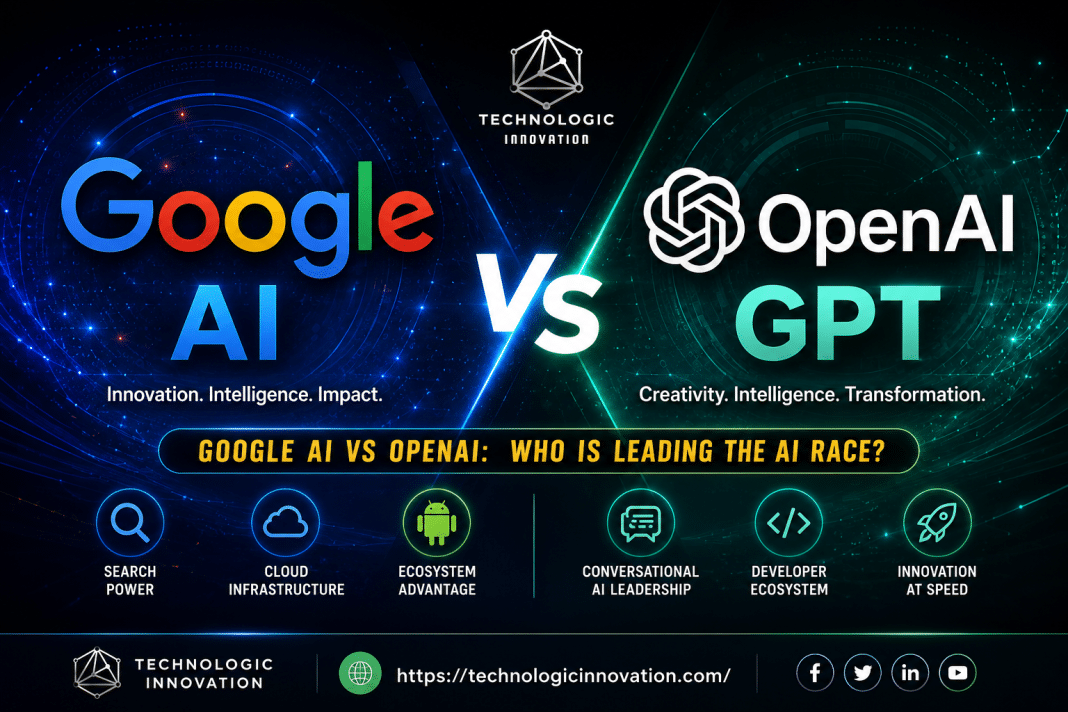

Artificial intelligence is changing how people search, work, create content, write code, and solve problems. Two companies sit at the center of this transformation: Google AI and OpenAI.
The competition between Google AI and OpenAI has become one of the most important technology battles of the decade. Both companies are pushing the limits of what AI can do, but they are taking different paths to get there.
Many people ask a simple question: Who is winning the AI race?
The answer is more complex than it seems.
In this guide, you’ll learn how Google AI and OpenAI compare across technology, innovation, products, business adoption, research, and future potential. You’ll also discover which company currently leads in specific AI categories and what that means for users and businesses.
Understanding the AI Race
Quick Answer
The AI race refers to the competition among technology companies to develop the most powerful, useful, and widely adopted artificial intelligence systems.
Success is measured through:
- Model performance
- User adoption
- Revenue growth
- Research breakthroughs
- Enterprise adoption
- Infrastructure capabilities
- Ecosystem development
Today, Google AI and OpenAI are among the strongest competitors in these areas.
A Brief History of Google AI and OpenAI
Google’s AI Journey
Google has invested in artificial intelligence for more than a decade.
Major milestones include:
| Year | Milestone |
|---|---|
| 2011 | Google Brain launched |
| 2014 | DeepMind acquired |
| 2017 | Transformer architecture introduced |
| 2023 | Bard launched |
| 2024 | Gemini introduced |
| 2025-2026 | AI integrated deeply into Search, Workspace, Android |
One of Google’s biggest contributions to AI was the Transformer architecture, which became the foundation of modern large language models.
Without Transformers, modern AI systems might not exist in their current form.
OpenAI’s Journey
OpenAI started in 2015 with a mission to develop advanced AI safely and broadly.
Major milestones include:
| Year | Milestone |
|---|---|
| 2015 | OpenAI founded |
| 2020 | GPT-3 launched |
| 2022 | ChatGPT released |
| 2023 | GPT-4 introduced |
| 2024 | Advanced multimodal models launched |
| 2025-2026 | AI agents and enterprise ecosystem expansion |
OpenAI transformed public awareness of AI more than any other company.
ChatGPT brought generative AI into everyday life.
Google AI vs OpenAI: Head-to-Head Comparison
| Category | Google AI | OpenAI |
|---|---|---|
| Search Integration | Excellent | Limited |
| Consumer Popularity | Strong | Very Strong |
| AI Research | Excellent | Excellent |
| Enterprise Adoption | Very Strong | Very Strong |
| Developer Ecosystem | Strong | Very Strong |
| AI Assistant Experience | Strong | Excellent |
| Infrastructure | Excellent | Strong |
| Innovation Speed | Strong | Excellent |
| Data Resources | Excellent | Moderate |
| User Experience | Strong | Excellent |
AI Models: Gemini vs GPT
Google Gemini
Gemini is Google’s flagship AI model family.
Key strengths:
- Multimodal capabilities
- Long-context understanding
- Native integration with Google products
- Strong reasoning performance
- Search-connected responses
Gemini works across:
- Search
- Android
- Gmail
- Google Docs
- Google Cloud
This gives Google a major distribution advantage.
GPT Models
GPT models power ChatGPT and many third-party applications.
Key strengths:
- Natural conversation
- Creative writing
- Coding assistance
- Tool usage
- Agent-based workflows
Many users prefer GPT because interactions often feel more natural and intuitive.
This user experience advantage helped ChatGPT become a global phenomenon.
Which Model Performs Better?
The answer changes frequently.
AI benchmarks evolve every few months.
In some evaluations:
- Gemini excels in multimodal tasks.
- GPT excels in conversational quality.
- Both perform well in coding.
- Both demonstrate advanced reasoning.
For most users, the difference often comes down to workflow preferences rather than raw intelligence.
Search: Google’s Biggest Advantage
Why Search Matters
Search remains one of the world’s most valuable digital products.
Google processes billions of searches daily.
This gives Google:
- Massive user reach
- Real-time information access
- Behavioral insights
- Strong advertising infrastructure
AI-Powered Search
Google has integrated AI directly into search experiences.
Benefits include:
- Faster answers
- Summarized information
- Better research workflows
- Context-aware results
This creates a powerful advantage because users do not need to leave Google’s ecosystem.
OpenAI’s Challenge
- OpenAI excels at conversational experiences but lacks Google’s dominance in search.
- While ChatGPT has become a popular information tool, Google still controls a significant portion of online discovery.
- This remains one of Google’s strongest strategic advantages.
Consumer Adoption: OpenAI’s Biggest Win
The ChatGPT Effect
OpenAI achieved something rare.
It turned advanced AI into a mainstream consumer product.
Millions of users quickly adopted ChatGPT for:
- Writing
- Coding
- Studying
- Research
- Brainstorming
- Productivity
Why People Love ChatGPT
Several factors contributed to ChatGPT’s success:
Simplicity
Users can start immediately.
No technical expertise is required.
Natural Conversations
Responses often feel intuitive and human-like.
Broad Use Cases
One tool solves many different problems.
Continuous Improvements
Frequent updates keep users engaged.
Consumer Perception
When many people think about AI today, they think about ChatGPT first.
This brand recognition gives OpenAI a significant competitive advantage.
Enterprise AI: A Tight Competition
Google’s Enterprise Strengths
Google offers powerful enterprise solutions through:
- Google Cloud
- Workspace
- Gemini integrations
- Security infrastructure
Organizations already using Google products can adopt AI more easily.
OpenAI’s Enterprise Strengths
OpenAI has built strong business offerings around:
- ChatGPT Enterprise
- API access
- Custom GPTs
- AI automation
Many startups and software companies build directly on OpenAI models.
Which Is Better for Businesses?
The answer depends on existing infrastructure.
Choose Google AI if:
- Your company uses Google Workspace.
- You rely heavily on Google Cloud.
- Search integration matters.
Choose OpenAI if:
- You need advanced AI assistants.
- You build AI-powered applications.
- User experience is a top priority.
AI Research and Innovation
Google’s Research Legacy
Google researchers have produced many groundbreaking AI innovations.
Examples include:
- Transformers
- Attention mechanisms
- Reinforcement learning advances
- Large-scale multimodal systems
Google’s research influence is enormous.
OpenAI’s Innovation Speed
OpenAI is known for rapid execution.
Instead of focusing only on research papers, OpenAI often transforms research into products quickly.
Examples include:
- ChatGPT
- AI assistants
- AI agents
- Consumer AI tools
This speed allows OpenAI to shape market expectations.
Infrastructure: Google’s Hidden Superpower
Why Infrastructure Matters
Powerful AI requires:
- Massive computing resources
- Data centers
- Specialized hardware
- Global networking
Infrastructure often determines long-term success.
Google’s Advantage
Google owns:
- Global data centers
- Custom TPUs
- Cloud infrastructure
- Massive engineering resources
Few companies can match this scale.
OpenAI’s Position
OpenAI has strong infrastructure partnerships and access to advanced computing resources.
However, Google still possesses one of the largest AI infrastructures in the world.
This could become increasingly important as models grow more expensive to train.
Developer Ecosystem Comparison
OpenAI’s Developer Advantage
Developers helped fuel OpenAI’s growth.
Thousands of applications use OpenAI APIs.
Popular use cases include:
- Chatbots
- Content generation
- Customer support
- Coding assistants
- Workflow automation
Google’s Growing Ecosystem
Google continues expanding:
- Gemini APIs
- Vertex AI
- Cloud AI services
- Enterprise integrations
The company benefits from its existing developer network.
Verdict
OpenAI currently enjoys stronger mindshare among AI-first developers.
Google remains a formidable competitor due to its cloud ecosystem.
Real-World Use Cases
Content Creation
OpenAI Strengths
- Blog writing
- Copywriting
- Brainstorming
- Editing
Google Strengths
- Workspace integration
- Collaborative productivity
- Research support
Software Development
Both companies offer powerful coding assistance.
Developers often choose based on:
- Workflow preferences
- Tool integrations
- API costs
- Existing infrastructure
Education
AI is transforming learning through:
- Personalized tutoring
- Research assistance
- Writing support
- Language learning
Both Google AI and OpenAI perform well in educational settings.
Common Mistakes When Comparing Google AI and OpenAI
Mistake #1: Focusing Only on Benchmarks
Benchmarks don’t always reflect real-world performance.
User experience matters.
Mistake #2: Assuming One Company Wins Everything
Different companies excel in different areas.
AI leadership is highly specialized.
Mistake #3: Ignoring Ecosystems
The best AI model isn’t always the best business choice.
Integration often matters more.
Mistake #4: Looking Only at Today’s Capabilities
AI evolves rapidly.
Leadership can shift within months.
Future Outlook: What Happens Next?
Areas to Watch
AI Agents
AI systems will increasingly perform tasks independently.
Multimodal AI
Models will combine:
- Text
- Images
- Audio
- Video
- Real-world interactions
Enterprise Automation
AI will automate more business workflows.
Personalized Assistants
AI assistants will become more proactive and context-aware.
Who Has the Better Future Position?
Google benefits from:
- Massive infrastructure
- Search dominance
- Android ecosystem
- Enterprise relationships
OpenAI benefits from:
- Consumer loyalty
- Strong developer adoption
- Rapid innovation
- Brand leadership in generative AI
Both companies have strong paths to long-term success.
Expert Perspective: The AI Race Has Multiple Winners
One common misconception is that AI resembles a sports competition with a single champion.
The reality is different.
History shows that multiple technology companies often succeed simultaneously.
Examples include:
- Apple and Microsoft
- AWS and Google Cloud
- Android and iOS
AI may follow a similar pattern.
Different organizations will lead different segments of the market.
Best Practices for Users and Businesses
To get the most value from AI:
- Focus on outcomes, not brands.
- Test multiple AI platforms.
- Compare real-world performance.
- Evaluate integration options.
- Monitor new releases regularly.
- Train teams on AI best practices.
- Build workflows around productivity gains.
Organizations that remain flexible will benefit the most.
FAQ
Is Google AI better than OpenAI?
Neither is universally better. Google AI excels in search integration and infrastructure, while OpenAI excels in conversational AI and consumer adoption.
Which AI model is more accurate?
Accuracy depends on the task. Both Gemini and GPT models perform strongly across reasoning, coding, writing, and research.
Why did OpenAI become so popular?
OpenAI popularized AI through ChatGPT, making advanced AI accessible to everyday users in a simple interface.
Does Google have an advantage because of Search?
Yes. Google’s search ecosystem provides massive distribution, real-time information access, and user reach.
Who is more likely to lead AI in the future?
Both companies are well-positioned. Google has infrastructure and ecosystem advantages, while OpenAI has strong consumer adoption and innovation momentum.
Related Reading
- Best AI Tools for Freelancers 2026
- ChatGPT vs Other AI Tools: Which One Is Better for Content Creation?
- Best Free AI Tools for SEO to Boost Marketing in 2026
Conclusion
The battle between Google AI and OpenAI is shaping the future of technology.
OpenAI changed how the world interacts with AI. ChatGPT brought artificial intelligence into homes, schools, and workplaces at unprecedented speed. The company continues to lead in user experience, AI assistants, and developer engagement.
Google, however, remains a powerhouse. Its search dominance, cloud infrastructure, research expertise, Android ecosystem, and enterprise reach create advantages that few organizations can match.
The most accurate answer to “Who is leading the AI race?” is that leadership depends on the category being measured.
- OpenAI leads in consumer mindshare and conversational AI.
- Google leads in infrastructure, search integration, and ecosystem scale.
- Both continue to push the industry forward.
For users and businesses, the smartest approach is not choosing sides. It is learning how to leverage the strengths of each platform to achieve better results, faster innovation, and greater productivity.