
Introduction
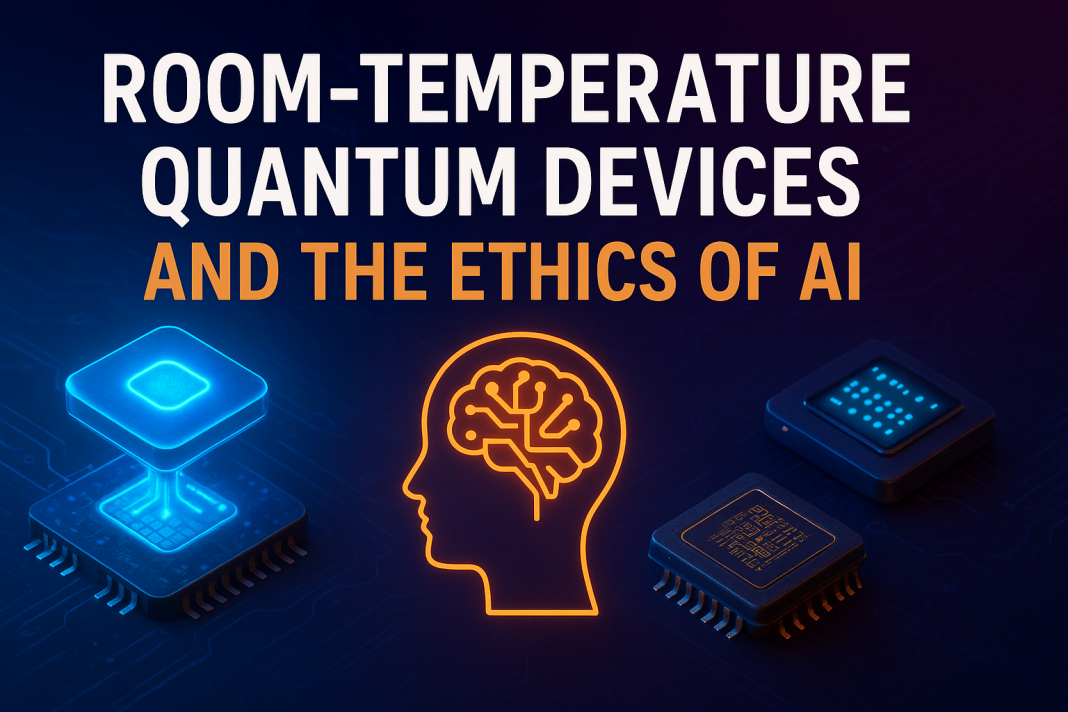
Two of the most transformative technologies of the 21st century—quantum computing and artificial intelligence (AI)—are moving from theory to practice. Recent progress in room-temperature quantum devices and ongoing debates around the ethics of AI highlight both the promise and responsibility of shaping our digital future.
Why Room-Temperature Quantum Devices Are a Breakthrough
Quantum devices typically require ultra-cold environments near absolute zero, making them expensive and difficult to scale. The development of room-temperature quantum systems marks a huge milestone.
Key Advantages
- Accessibility: Reduces reliance on costly cryogenic setups.
- Scalability: Easier integration into data centers and labs.
- Energy Efficiency: Lower power consumption compared to traditional cooling systems.
- Real-World Use: Opens the door for broader adoption across industries.
Example in Practice
Researchers are experimenting with diamond-based quantum sensors and photonic qubits that operate at room temperature, paving the way for next-gen communication and encryption systems.
Potential Applications of Room-Temperature Quantum Devices
- Healthcare: Advanced imaging and molecular simulations for drug discovery.
- Cybersecurity: Unbreakable quantum encryption for data protection.
- Finance: Faster, more accurate risk modeling.
- Climate Science: Simulations to better predict and mitigate climate change impacts.
The Ethical Side of Artificial Intelligence
While quantum devices push hardware boundaries, AI raises deep ethical questions about how such power should be used.
Key Ethical Concerns
- Bias and Fairness: AI models often reflect existing social biases.
- Privacy: Data-driven systems can misuse personal information.
- Accountability: Who is responsible when AI makes a wrong decision?
- Job Displacement: Automation risks affecting millions of workers.
- Weaponization: Dual-use AI poses security risks.
Case Example
In healthcare AI, bias in training data has led to unequal treatment recommendations. Ethical frameworks are now being pushed to ensure fairness and transparency.
The Intersection: Quantum + AI
The real future lies at the intersection of quantum devices and AI. Quantum computing can supercharge AI by processing vast datasets faster, while AI can optimize quantum experiments. But combining them also intensifies ethical concerns.
- Enhanced Surveillance: AI with quantum speed could process massive surveillance data in real time.
- Privacy Risks: Quantum decryption could break current encryption, raising security concerns.
- Unequal Access: Wealthy nations and corporations may dominate these technologies, widening global inequality.
Challenges Ahead
- Technical: Scaling room-temperature quantum devices for commercial use.
- Ethical: Ensuring AI aligns with human values.
- Regulatory: Creating global standards for safe deployment.
- Economic: Avoiding monopolies in these emerging fields.
Conclusion
Room-temperature quantum devices represent a leap toward practical, accessible quantum technology. At the same time, the ethics of AI demand thoughtful frameworks to prevent misuse. Together, these technologies could redefine society—if guided responsibly. The real challenge isn’t just technological innovation, but ensuring progress benefits everyone.
Related Reading
- 3D Printing and Chiplet Technology: The Future of Manufacturing.
- Next-Generation Battery Technology and Advanced Materials Explained.
- The Benefits of Cloud Computing for Businesses.
FAQs
1. What makes room-temperature quantum devices different?
They function without cryogenic cooling, making them cheaper and more practical for real-world applications.
2. Why is AI ethics important?
Because unchecked AI can lead to bias, privacy violations, and misuse in critical areas like healthcare and security.
3. Can quantum computing make AI more powerful?
Yes. Quantum devices could allow AI to analyze massive datasets much faster than current systems.
4. What risks arise when combining AI and quantum tech?
Potential risks include mass surveillance, privacy breaches, and uneven access to these technologies.
5. How can we ensure ethical AI?
By setting global standards, using diverse datasets, and demanding transparency in decision-making systems.