


Introduction.
Communication technologies are gradually moving beyond conventional screens and displays in today’s swiftly changing digital environment. Of these, 3D holographic technology is particularly noteworthy as a revolutionary advancement that is revolutionizing the way we interact and visualize information. 3D holograms, in contrast to flat 2D images, create immersive, nearly mystical experiences by projecting realistic three-dimensional graphics that can be viewed from any angle. This article examines the operation of 3D hologram technology, as well as its uses, advantages, and prospects for this cutting-edge visual communication medium.
3D Hologram Technology: What is it?
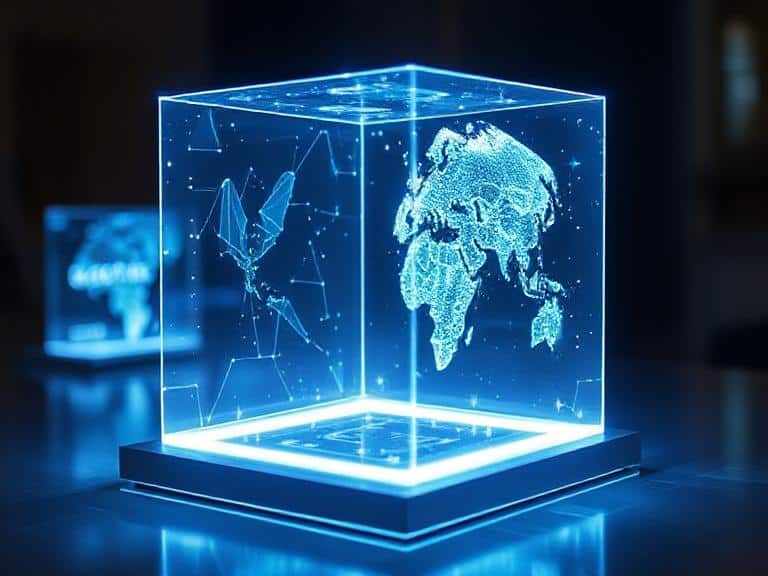
A three-dimensional hologram is a light projection that creates a three-dimensional object in space. It does not require special glasses or headsets such as virtual reality (VR) or augmented reality (AR). Viewers can rotate and observe it from different angles as it creates a realistic visual reproduction of objects, people or places using light interference patterns.
The following technologies are used to create holograms.
- Laser projection
- Optical components (lenses and mirrors)
- Digital light processing (DLP)
- Holographic display panels
Important Uses for 3D Hologram Technology
1. Communication and Business
In order to create a significant presence without the need for actual travel, businesses are now deploying 3D holograms for interactive presentations, product demonstrations, and even beaming executives to distant regions in real-time.
2. Instruction and Practice
In medical schools and classrooms, 3D holograms offer interactive, visual teaching aids that improve students’ comprehension of difficult subjects like human anatomy or engineering designs.
3. Medical Care
Holograms are employed in medicine for training, medical imaging, and surgical planning. More precise diagnosis and treatments can result from surgeons’ ability to examine organs and tissues in three dimensions.
4. Media and Entertainment
Holograms are already being used by the entertainment industry to enthrall audiences like never before, from immersive storytelling to concerts that feature holographic representations of departed performers.
5. Advertising and Retail
To attract customers and improve the shopping experience, retailers utilize 3D holograms for in-store promotions, virtual mannequins, and product presentations.
Benefits of Holographic 3D Technology
- No specialized equipment is needed: In contrast to VR, users do not require wearables or eyewear.
- Complete 360-degree views of items or surroundings are examples of immersive experiences.
- Real-time, life-sized virtual conversation is made possible through remote engagement.
- Improved learning and engagement: Increases comprehension and retention in learning environments.
- Eco-friendly presentations: Save time and energy by reducing the need for travel.
Obstacles and Restrictions
- High setup and production costs
- Low resolution in displays intended for consumers
- Clarity can be impacted by environmental factors including lighting.
Technology with a lot of data that needs a lot of processing power
Many of these problems are gradually being fixed as technology develops, increasing the use and accessibility of 3D holograms.
In conclusion
No longer a work of science fiction, 3D holographic technology is a quickly developing invention that is revolutionizing communication, education, learning, and entertainment. We may anticipate 3D holograms becoming a commonplace aspect of our life as hardware and software grow more accessible and potent. The future of visual communication is genuinely holographic, from virtual doctors in distant clinics to holographic lecturers in classrooms.
FAQs: Technology for 3D Holograms
Q1: What distinguishes virtual reality from 3D holograms?
A: Unlike virtual reality (VR), which uses wearable technology to immerse viewers in a simulated world, 3D holograms are visible to the unaided eye and do not require goggles or headsets.
Q2: Do 3D holograms exist as actual physical objects?
A: No, they are light projections that give the appearance of a real thing in space.
Q3: Is it possible to employ holograms for live communication?
A: It is possible to use holographic telepresence to make real-time appearances as life-sized 3D projections during meetings or events.
Q4: How much does 3D holographic technology cost?
A: Because of sophisticated hardware and software, it can be expensive at the moment, but costs should decrease as the technology becomes more widely used.
- Q5: Which sectors gain the most from holographic technology?
A few of the top industries using 3D holograms are education, healthcare, business, retail, and entertainment.


