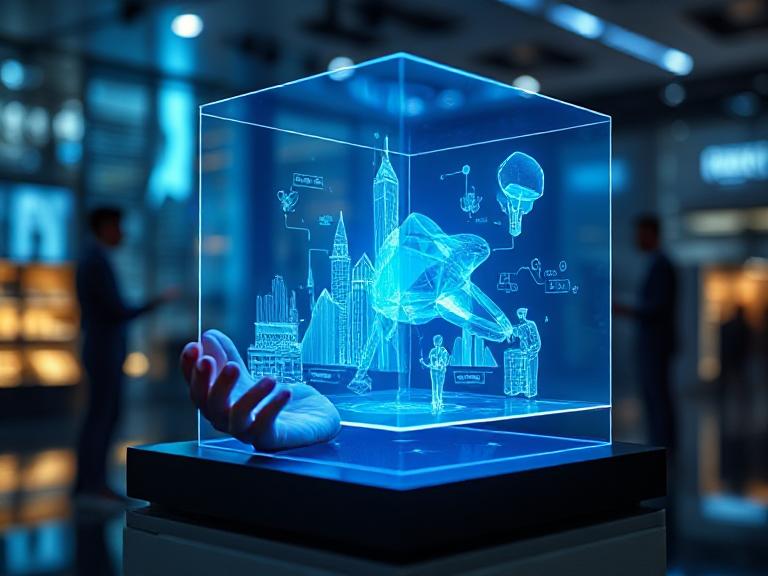


Headsets for virtual reality (VR) and augmented reality (AR) have long been the preferred tools for creating immersive online experiences. However, the quick development of 3D holographic technology raises a fresh query: Will these headsets soon become outdated?
Hologram technology projects 3D images into real space without the need for a headset, in contrast to conventional AR/VR systems that rely on wearable hardware to replicate immersion. Everything from communication and entertainment to healthcare and education is beginning to change as a result of this revolutionary invention.
We previously explored the versatility of holograms in The Future of Visual Communication. Let’s now evaluate whether holograms can truly dethrone AR and VR hardware.
Holograms vs. AR/VR Headsets
Immersion
- Although AR/VR headsets provide complete sensory immersion, they separate the user from their actual surroundings.
- 3D holograms: Integrate digital components into real-world environments to enable interaction without a screen.
Accessibility
- Headsets: Need specialized equipment, which is frequently expensive and large.
- Holograms: New technologies such as PORTL, Holoxica, and Looking Glass don’t require wearables, which makes them more inclusive and accessible.
Applications
- Holograms are gaining popularity in:
- Remote collaboration
- Medical training (See: Holograms in Healthcare)
- Virtual meetings (Revolutionizing Virtual Meetings)
Key Advantages of Holograms
- Wearable technology is not necessary.
- Real-time multi-user interaction
- Reduced access barriers in business and education
- A more engaging and organic experience
What Are the Limitations?
- Cost & Scalability: Holographic displays of commercial quality are still pricy.
- Visual Fidelity: Although holograms are rapidly developing, they still fall short of virtual reality headsets in terms of quality.
- Ambient Light Sensitivity: In very bright settings, display quality may deteriorate.
Despite these obstacles, holographic technology is developing quickly and catching up.
The Verdict: Replacement or Complement?
3D holographic technology is positioned to supplement and eventually overtake AR/VR headgear in certain fields, particularly when natural interaction, accessibility, and teamwork are crucial.
The development of holographic projection could perhaps usher in a time without screens or headsets.