Introduction.
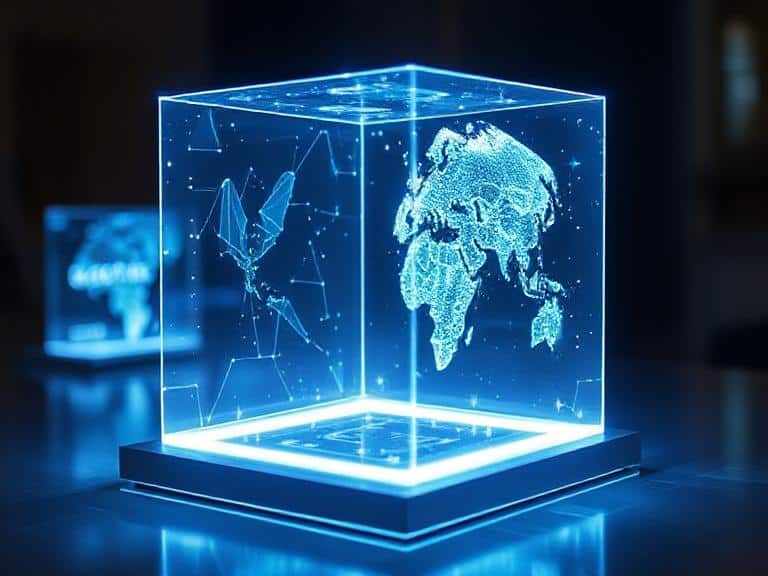
New technologies are changing education and training at a rapid pace, changing the way we teach and learn. Among these developments, 3D holographic technology is particularly revolutionary. Without the use of screens or headsets, 3D holograms provide an incredibly engaging and interactive experience by projecting lifelike, three-dimensional images into actual space. From corporate training programs and medical schools to classrooms and universities, this cutting-edge technology is making education more effective, accessible, and engaging than it has ever been.
Read more: 3D Hologram Technology: The Future of Visual Communication
3D Holograms in Education: What Are They?
Light-based projections known as 3D holograms provide the appearance of actual 3D things floating in space. Anatomical models, historical recreations, chemical structures, and technical blueprints are just a few examples of what might be used in instructional contexts. Holograms, as opposed to conventional 2D pictures or films, let students watch, engage, and learn in real time from all perspectives.
Read more: Holographic Displays: The First Step Into a New Dimension of Technology in 2025
Among the technologies used are:
- Light projection and laser
- Motion detection for communication
- Panels with holographic displays
- Tools for modeling and designing digital content
Principal Advantages of 3D Holograms for Training and Education
- Enhanced Engagement
With 3D content, students are inherently more interested. Holograms provide interactive engagement and visual stimulation, which greatly improves focus and memory.
- Improved comprehension of intricate ideas
Abstract or complicated concepts are frequently involved in subjects like biology, chemistry, and physics. These ideas can be explored and visualized in a concrete way thanks to holograms.
- Secure, Practical Education
Students can train on holographic simulations rather than actual patients or pricey equipment in professions like engineering or medicine, which lowers risk while enhancing skills.
- Distance Education with Instant Communication
By allowing teachers or specialists to appear in 3D in distant classrooms, holographic telepresence enhances the intimacy and interactivity of distance learning.
- Tailored and Flexible Education
Holographic systems are able to adjust to different learning preferences by providing interactive tests and personalized content to fit the speed and comprehension of each student.
Holographic systems are able to adjust to different learning preferences by providing interactive tests and personalized content to fit the speed and comprehension of each student.
Applications in Different Fields
Medical Education
- 3D holograms of human organs and systems allow students to explore anatomy in real-time.
- Virtual surgeries can be practiced before real-life operations.
STEM Learning
- Mathematics and engineering models are easier to grasp with visual 3D models.
- Physics simulations can demonstrate force, motion, or energy in action.
Corporate Training
- Reduces the cost of travel and physical equipment.
- Employees can be trained in soft skills, safety procedures, or product usage using interactive holographic simulations.
Vocational and Technical Training
- Automotive, electronics, and aviation students can inspect machines in 3D, disassemble and reassemble virtually, without damaging any real equipment.
Challenges to Consider
- High cost of holographic hardware and software
- Need for technical skills to develop and maintain holographic content
- Limited availability in rural or underfunded educational institutions
- Environmental requirements (controlled lighting and space)
Despite these hurdles, the cost of 3D hologram technology is steadily decreasing, and more schools and institutions are beginning to adopt it.
Conclusion
3D hologram technology is reshaping education and training across disciplines. By providing interactive, realistic, and immersive experiences, it bridges the gap between theoretical knowledge and practical application. Whether it’s dissecting a heart in medical school or practicing a mechanical repair in a trade class, holograms are enhancing learning like never before. As technology becomes more accessible, we can expect 3D holographic learning to become a vital part of classrooms and training centers worldwide.
FAQs: 3D Holograms in Education and Training
Q1: Do 3D holograms require special glasses or headsets?
A: No, most 3D holograms are viewable with the naked eye and do not require VR or AR headsets.
Q2: How are holograms better than videos or slides in teaching?
A: Holograms allow students to interact with 3D content, providing a more engaging and deeper understanding of the material.
Q3: Can 3D holograms be used in remote or online education?
A: Yes, holographic telepresence allows instructors to appear as 3D holograms in distant classrooms, making remote learning more interactive.
Q4: Are holograms safe for children and students to use regularly?
A: Yes, they are completely safe since they use non-invasive light projection. There is no radiation or physical risk involved.
Q5: What is the future of holograms in education?
A: As the technology becomes cheaper and more advanced, it is expected to be a standard tool in modern classrooms, especially for STEM, medical, and vocational subjects.