

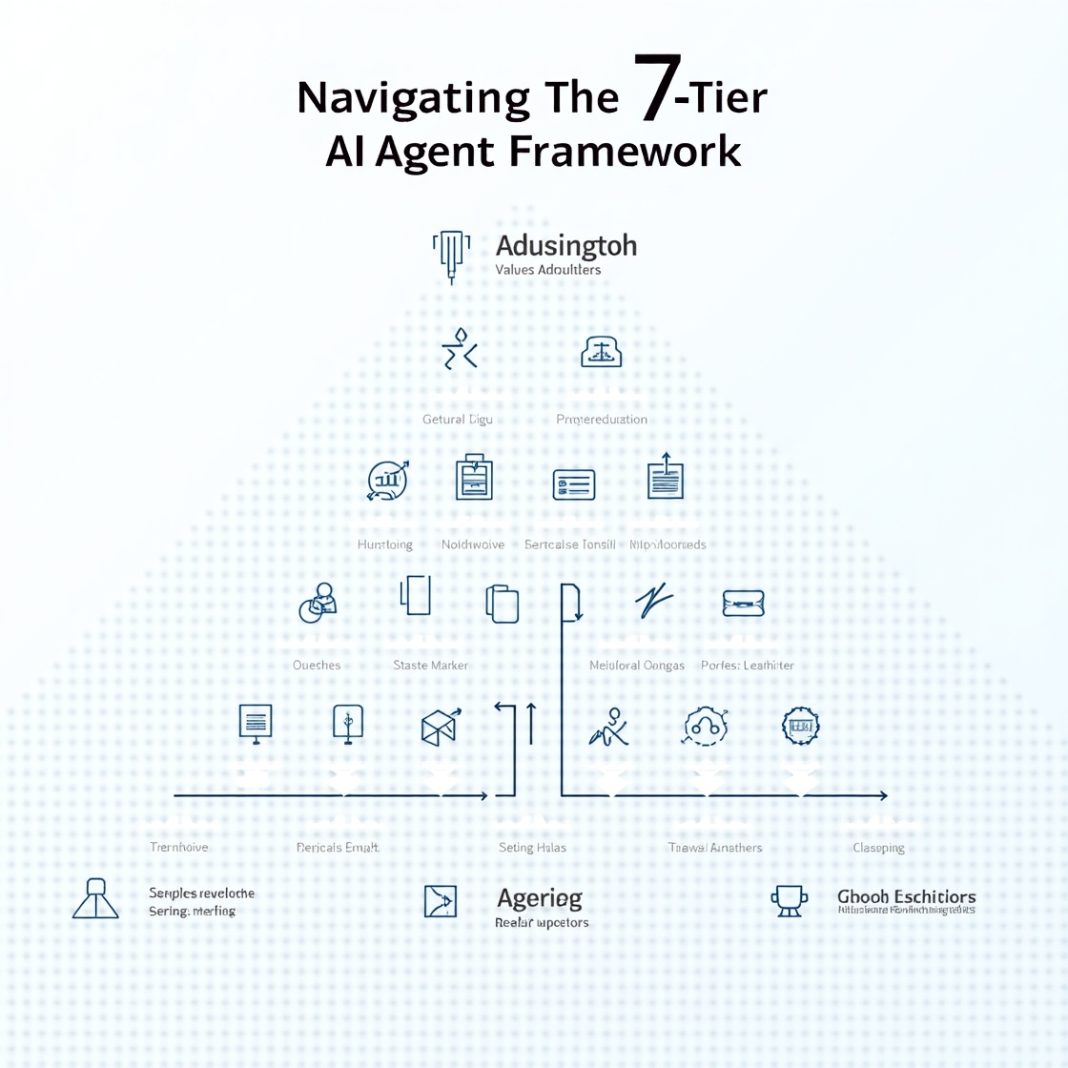

In today’s fast-paced digital economy, artificial intelligence (AI) is no longer a luxury — it’s the backbone of efficient operations. Businesses, creators, and innovators are leveraging AI agents to save time, increase productivity, and improve safety in decision-making. The 7-Tier AI Agent Framework offers a clear roadmap for structuring AI systems so they work smarter, faster, and safer. Whether you’re a tech leader or just curious about how AI works behind the scenes, this guide will help you understand each tier in a friendly and practical way.
What is the 7-Tier AI Agent Framework?
Think of it like a skyscraper with seven floors. Each floor has a specific role, and together they make the building — or in this case, the AI system — strong and reliable. This framework helps developers and organizations design AI that can think, act, and learn in a way that’s both efficient and secure.
Why “Smarter, Faster, Safer” Matters in AI
- Smarter: AI should not just process data — it should make better decisions based on context and goals.
- Faster: Time is money. AI must reduce delays and streamline operations.
- Safer: Every automation must be reliable, ethical, and compliant with regulations.
A 2024 McKinsey report found that organizations using structured AI frameworks saw up to 45% faster decision-making and 30% fewer operational errors compared to those using ad-hoc AI systems.
Tier 1: Data Collection & Integration
This is the foundation of any AI system. Without good data, even the smartest AI will fail. Here, the focus is on gathering accurate, up-to-date information from multiple sources — databases, APIs, IoT devices, and even human input.
Example: An AI-powered medical assistant pulling data from hospital records, wearable health trackers, and real-time patient monitoring devices.
Tier 2: Data Processing & Cleaning
Raw data is messy. This tier ensures that data is structured, cleaned, and ready for analysis. Removing duplicates, fixing errors, and standardizing formats are essential for better performance.
Stat: According to IBM, data scientists spend 80% of their time cleaning and organizing data before analysis.
Tier 3: Intelligence Layer (Core AI Models)
This is where the AI’s brain lives. It uses machine learning models, natural language processing (NLP), and computer vision to understand and interpret the data.
Example: In e-commerce, AI can analyze purchase patterns to recommend products to customers instantly.
Tier 4: Decision-Making Engine
The decision-making engine applies business rules, ethical considerations, and predictive insights to choose the best action. It’s like the “executive” of the AI system.
Example: In self-driving cars, this tier decides whether to slow down, change lanes, or stop, based on road and traffic conditions.
Tier 5: Action Execution
Once a decision is made, the AI takes action — whether it’s sending a notification, executing a workflow, or controlling a machine.
Example: In customer service, AI can automatically send personalized follow-up emails after a support ticket is resolved.
Tier 6: Feedback & Learning
AI doesn’t just act — it learns. This tier collects feedback from outcomes to improve future performance, using reinforcement learning or human-in-the-loop feedback.
Example: A fraud detection AI improves its accuracy as it learns from both confirmed fraud cases and false alarms.
Tier 7: Monitoring & Governance
This is the safety net. It ensures the AI operates ethically, securely, and in compliance with regulations like GDPR or HIPAA. Monitoring tools track AI decisions to detect biases or errors.
Example: A financial AI system that flags suspicious transactions but also logs every decision for auditing purposes.
Benefits of Using the 7-Tier AI Agent Framework
- Clarity: Each tier has a dedicated role, making development and troubleshooting easier.
- Scalability: You can upgrade or replace individual tiers without disrupting the whole system.
- Safety: Built-in monitoring reduces risks of errors or unethical decisions.
- Speed: Streamlined processes help deliver results faster, from milliseconds in stock trading to minutes in complex supply chain operations.
Real-World Example: Smarter, Faster, Safer in Action
Imagine a logistics company that uses the 7-Tier AI Agent Framework.
- Tier 1 & 2: It collects GPS, weather, and traffic data and cleans it.
- Tier 3 & 4: AI predicts delays and suggests alternative routes.
- Tier 5: Dispatchers automatically update driver instructions.
- Tier 6: AI learns from previous deliveries to improve estimates.
- Tier 7: The system complies with transport regulations and monitors for unsafe driving behavior.
Result: Faster deliveries, lower fuel costs, and improved safety for drivers.
Conclusion
The 7-Tier AI Agent Framework is not just a technical concept — it’s a practical tool for building AI systems that are intelligent, efficient, and trustworthy. By breaking AI into structured layers, organizations can develop solutions that truly deliver on the promise of being smarter, faster, and safer. Whether you’re building a chatbot, an industrial automation system, or a self-driving car, this framework ensures you’re not just building AI — you’re building the right AI.
Related Reading
- How Lenovo Is Shaping Ethical, Green, and Inclusive AI for the Future.
- Lenovo’s Vision for Sustainable AI: Tech That Serves People and the Planet
- Dell’s AI Data Platform Delivers Instant Insights with NVIDIA and Elastic Power
FAQs
Q1: Who should use the 7-Tier AI Agent Framework?
Anyone designing AI systems, from startups to large enterprises, can benefit from this structured approach.
Q2: Does every AI need all seven tiers?
Not necessarily. Smaller AI tools may combine tiers, but the framework ensures no critical step is skipped.
Q3: How does this framework improve safety?
Tier 7 (Monitoring & Governance) continuously checks for compliance, bias, and security issues.
Q4: Can it work with existing AI tools like ChatGPT or n8n?
Yes, you can integrate these tools into specific tiers, such as decision-making or action execution.


