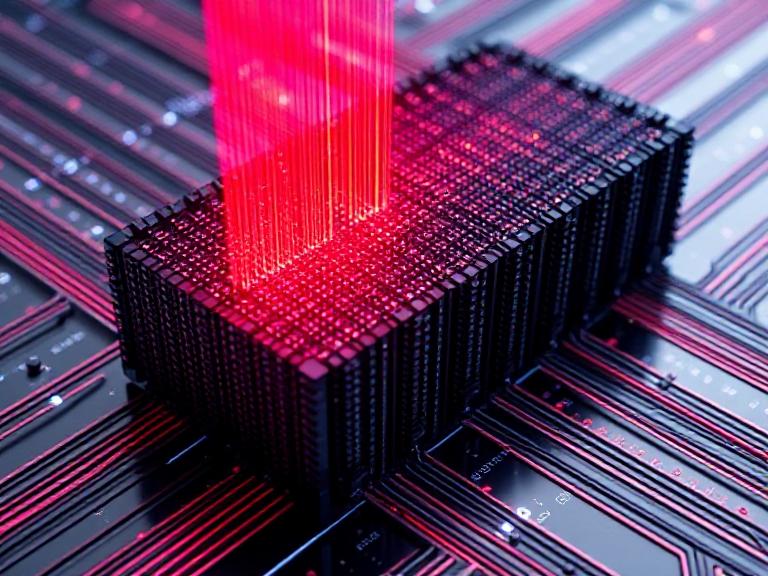

Introduction: The Scaling Problem in Quantum Computing
Massive computational power is promised by quantum computing, but scaling it is still one of the biggest obstacles. Photonic quantum computers, such as those created by PsiQuantum, offer a new route that is both full of prospects and challenging from an engineering standpoint, whereas typical qubit systems are limited by hardware.
PsiQuantum is making daring moves to get over these obstacles, which range from photon loss to circuit integration to reaching a million-qubit architecture.
The Photon Loss Problem
Due to their speed, mobility, and lack of interaction, photons make perfect qubit carriers. However, a significant obstacle when scaling large quantum circuits is their susceptibility to loss during transmission.
PsiQuantum’s Solution:
- Ultra-low-loss waveguide development
- Application of error-resilient encodings and quantum repeaters
- To guarantee signal integrity, use redundant photon pathways.
Related: How Quantum Error Correction Works in PsiQuantum’s Architecture
Circuit Integration at Scale
As the number of qubits grows, linking photonic components becomes increasingly difficult. The integration of photon sources, waveguides, beam splitters, and detectors on a single chip is a difficult process.
PsiQuantum’s Solution:
- Using CMOS-compatible silicon photonics.
- Precision quantum photonic chips created in commercial semiconductor facilities.
- Modular structures facilitate mass production.
Read more: PsiQuantum: Revolutionizing Computing with Photonic Quantum Technology
Scaling Qubit Count to Millions
Scaling quantum systems requires careful coordination of entanglement, synchronization, and error correction, in contrast to traditional computing, where adding more transistors is simple.
PsiQuantum’s strategy:
- Creating a fault-tolerant cluster-state machine.
- Aiming for one million error-corrected logical qubits
- Topological quantum error correction using continuous photon observations.
Explore: Top 5 Breakthroughs in Deep AI You Should Know About
Hardware and System-Level Challenges
Photon detectors must have great sensitivity. Delays in timing synchronization and hardware overhead can have an impact on system performance.
PsiQuantum Fixes:
- Ultra-fast single-photon detectors
- On-chip clock synchronization and latency control.
- Redundant routing layers to prevent congestion and delay.
Future Outlook: Solving Today’s Challenges for Tomorrow’s Quantum Breakthroughs
PsiQuantum’s emphasis on scalability via photonic integration and sophisticated manufacturing takes us closer to practical, fault-tolerant quantum computers. These advancements might soon drive advances in health, artificial intelligence, encryption, and materials research.
Frequently Asked Questions
Q: What makes scaling photonic quantum computers difficult?
A: Photon loss, chip integration, and achieving high qubit counts are major technical and engineering challenges in photonic quantum systems.
Q: How does PsiQuantum plan to overcome photon loss?
A: PsiQuantum uses ultra-low-loss waveguides, redundancy in circuits, and error-correcting encodings to mitigate photon loss.
Q: What is unique about PsiQuantum’s integration strategy?
A: They use silicon-based CMOS photonics to mass-produce modular, integrated quantum chips in commercial semiconductor facilities.
Q: How many qubits does PsiQuantum aim to scale to?
A: PsiQuantum’s goal is to create systems with over 1 million error-corrected logical qubits for commercially useful quantum computing.
Q: What are the benefits of solving scaling issues?
A: Solving these challenges allows quantum computers to support applications in logistics, AI, cryptography, and pharmaceutical discovery with reliable fault tolerance.