
Introduction
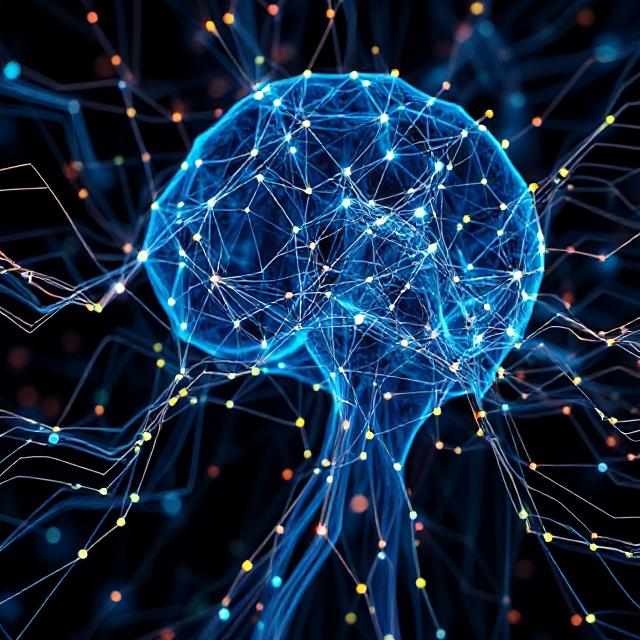
One technology that stands out in the field of artificial intelligence (AI) for its revolutionary potential is the neural network. Neural networks, which draw inspiration from the structure of the human brain, are the basis for advancements in computer vision, machine learning, natural language processing, and other fields.
This article examines neural networks’ definition, operation, main elements, varieties, uses, and the reasons they will be crucial in determining the direction of artificial intelligence in the future.
What is a Neural Network?
Comprising interconnected nodes, or “neurons,” a neural network is a computational system that collaborates to identify patterns and resolve challenging issues. These models allow machines to learn from data, adapt, and make wise decisions by simulating how human brains process information.
A fundamental component of deep learning, a branch of machine learning, are neural networks.
How Neural Networks Work
Neuronal layers enable neural networks to function:
- Raw data, such as text, numbers, and image pixels, is received by the input layer.
- Hidden Layers: Use activation functions and weights to carry out calculations.
- The output layer generates the final categorization or prediction.
The network learns to minimize errors by adjusting the weights assigned to each neuronal link, which controls the signal strength.
Key Components of Neural Networks
Neurons (Nodes)
Basic processing units that receive inputs, process them, and pass the output to the next layer.
Weights
Weights are numerical values that indicate how much of an impact a neuron has on another.
Activation Functions
ReLU, Sigmoid, and Tanh are among the functions that determine whether or not a neuron should be engaged.
Loss Function
The Loss Function calculates the difference between the actual value and the model’s prediction.
Backpropagation
use algorithms such as Gradient Descent to update weights by reducing the loss function.
Types of Neural Networks
Feedforward Neural Networks (FNN)
- In its most basic form, information flows in a single direction.
Convolutional Neural Networks (CNN)
- Outstanding for processing images and videos.
Recurrent Neural Networks (RNN)
- intended for language processing and sequential data, such as time series.
Generative Adversarial Networks (GANs)
- used to create fresh data—such as deepfakes or AI art—that is comparable to the training data.
Transformer Networks
- the structure underlying sophisticated NLP models such as BERT and GPT.
Applications of Neural Networks
Nowadays, neural networks are utilized in practically all AI-driven solutions:
- Voice assistants, such as Siri and Alexa
- Recognition of Faces
- Fraud Identification
- Translation of Languages
- Medical Evaluation
- Autonomous Automobiles
- Forecasts for the Stock Market
Advantages of Neural Networks
- able to grow and learn throughout time
- Outstanding at identifying patterns
- manages unstructured and complicated data
- enables intelligent operations to be automated
Challenges and Limitations
- need huge datasets for instruction
- can require a lot of computing power.
- prone to overfitting if improperly handled
- Interpretation is more difficult (black box difficulty).
The Future of Neural Networks
Neural networks are developing into more effective and scalable models as hardware gets more potent and data becomes more plentiful. Among the upcoming developments are:
- Computing that is neuromorphic
- XAI, or explainable AI
- Using lightweight neural nets for edge AI
- Few-shot and self-supervised learning
The core of AI innovation will remain neural networks, which will revolutionize sectors including manufacturing, healthcare, finance, and education.