Introduction.
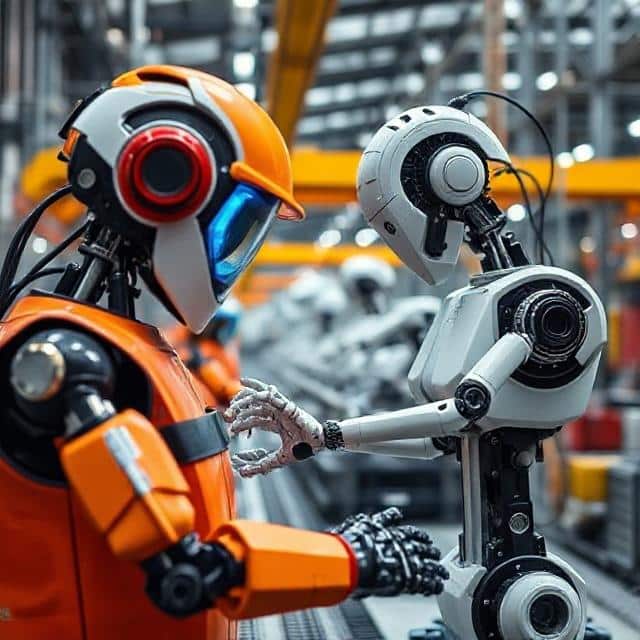
China is implementing advanced AI-powered humanoid robots in an audacious attempt to transform its manufacturing sector. The nation is using robotics and artificial intelligence (AI) to keep ahead of the competition as it deals with aging labor costs, growing labor expenses, and international rivalry. Chinese IT companies are vying to develop robots that can carry out intricate operations in factories, warehouses, and other locations, supported by billions of dollars in government financing and quick technological improvements.
Humanoid Robots’ Ascent in China.
China has made considerable investments in robotics in recent years. Humanoid robots that can walk, grab objects, and collaborate with people are being developed by companies such as UBTech, Agibot, and Fourier Intelligence.
These robots can absorb visual information, comprehend voice commands, and make decisions in real time thanks to sophisticated AI models like DeepSeek and Qwen. They are used for jobs like these in a variety of industries:
- Work on an assembly line
- Control of quality
- Transportation and logistics
- Handling hazardous materials
The Chinese government has set a lofty target: by 2025, the nation wants to produce significant quantities of general-purpose humanoid robots and extensively incorporate them into industrial processes.
Humanoid robots: why?
One special benefit of humanoid robots is their ability to be made to behave and act like humans, which makes them appropriate for settings that are already set up for human labor. This speeds up their adoption by lowering the requirement to modify factories or workflows.
Among the main advantages are:
- Support for workers when there is a labor shortage
- Enhanced efficiency through round-the-clock operating
- Increased security in dangerous situations
- Increased accuracy and reliability when doing repetitive activities
Challenges Ahead
Despite their promise, humanoid robots still face hurdles:
- High production costs
- Limited dexterity compared to humans
- Need for advanced software and AI training
- Social and ethical concerns over job displacement
China’s tech companies and government are actively addressing these issues through continued R&D, subsidies, and collaborations with academic institutions.
Conclusion
China’s integration of AI-powered humanoid robots into its manufacturing sector represents a significant shift toward automation and technological leadership. By investing heavily in robotics, the country aims not only to solve domestic labor challenges but also to become a global hub for robotic innovation. While challenges remain, the progress made so far signals a transformative future where humans and robots work side by side.
Related Reading.
- Branches of Artificial Intelligence: A Comprehensive Guide
- Artificial Intelligence vs. Machine Learning: Understanding the Difference
- Limited Memory AI: Powering Intelligent Decision-Making with Data
FAQs
Q1: Why is China investing in humanoid robots?
A: To address labor shortages, reduce manufacturing costs, and maintain global competitiveness in industrial automation.
Q2: What industries will benefit the most from humanoid robots in China?
A: Manufacturing, logistics, electronics, healthcare, and hazardous material handling.
Q3: Are these robots currently in use or still in development?
A: Some are already in pilot use in factories, but mass deployment is expected by 2025.
Q4: How is AI integrated into these robots?
A: Through advanced models that allow for vision recognition, language processing, movement coordination, and real-time decision-making.
Q5: Will robots replace human workers?
A: Robots are likely to augment human labor rather than fully replace it, especially in repetitive or dangerous tasks.