
Introduction: Why Carbon Tracking Matters in 2025
Carbon emissions are no longer just an environmental issue—they’re a business challenge. With stricter regulations, investor expectations, and customer demand for green practices, companies must prove measurable climate action.
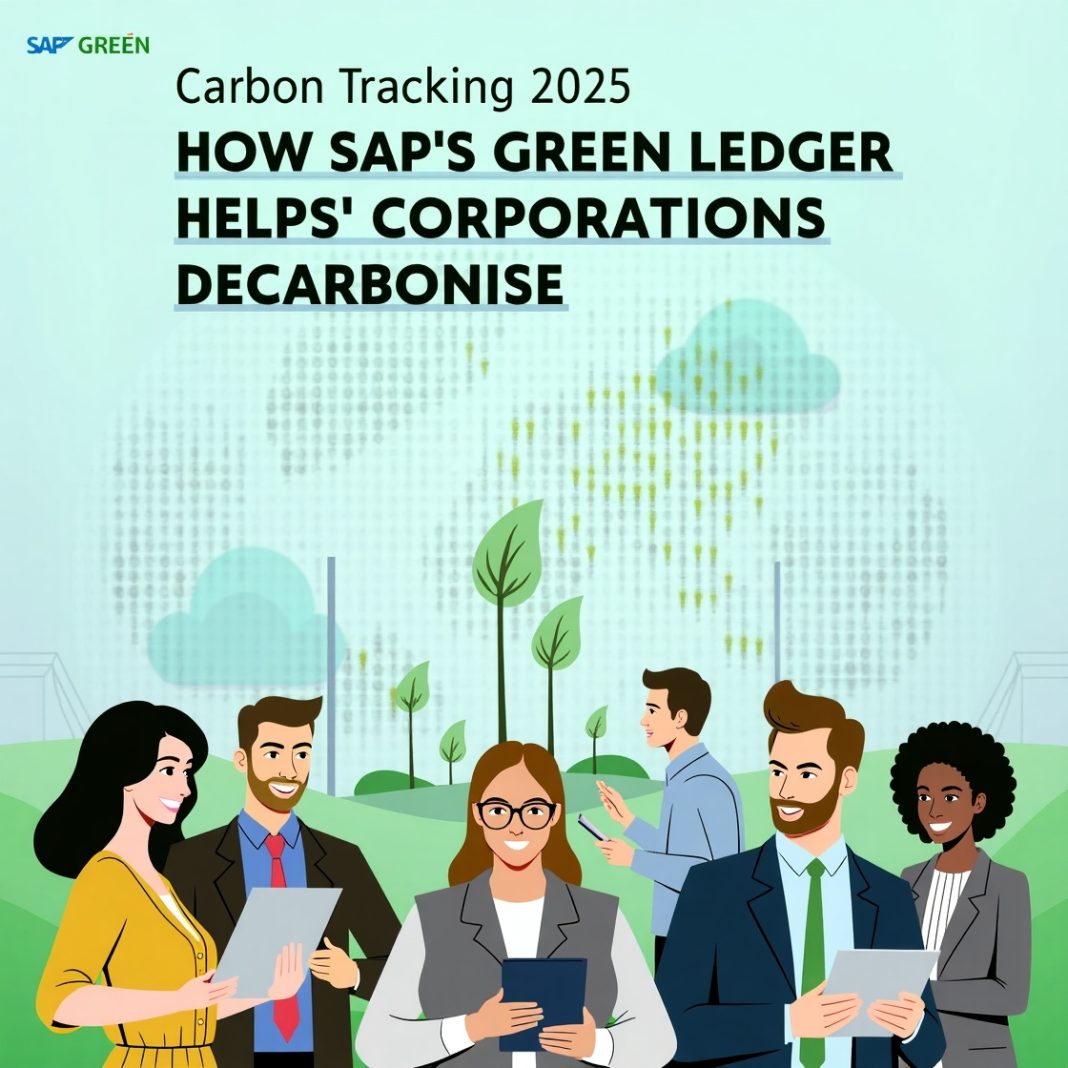
This is where SAP’s Green Ledger comes in. It’s not just software—it’s a sustainability game-changer, helping corporations track, manage, and reduce their carbon footprint with financial-grade accuracy.
What Is SAP’s Green Ledger?
SAP introduced the Green Ledger as part of its broader sustainability suite. Think of it as a digital carbon ledger, similar to a financial ledger, but designed for tracking emissions.
It allows businesses to:
- Record carbon emissions with transaction-level detail.
- Align sustainability data with financial accounting systems.
- Report real-time progress on decarbonisation goals.
By integrating environmental and financial data, companies can see the true cost of carbon alongside their traditional balance sheets.
Why Traditional Carbon Tracking Falls Short
Most businesses still rely on spreadsheets or disconnected tools to calculate emissions. These methods often:
- Lack real-time updates.
- Fail to integrate with financial data.
- Struggle with audit-ready reporting for regulators.
The result? Delayed insights and a “best-guess” approach to carbon reduction. SAP’s Green Ledger solves these problems.
How SAP’s Green Ledger Helps Corporations Decarbonise
1. Real-Time Carbon Accounting
Companies can track emissions at the same pace as financial transactions. This means every shipment, purchase order, or manufacturing process has an attached carbon footprint.
2. Accurate ESG Reporting
With compliance standards like CSRD (Corporate Sustainability Reporting Directive) and SEC climate disclosures, accuracy matters. SAP’s Green Ledger ensures reporting meets global standards.
3. Operational Insights for Cost and Carbon
By linking carbon data with financial records, decision-makers can see how emission-heavy processes impact both profits and sustainability.
Example: A logistics company discovers that shifting from air freight to rail reduces both carbon costs and financial costs.
4. Benchmarking and Goal Setting
Businesses can measure progress toward net-zero targets and benchmark against industry peers.
Real-World Example: Manufacturing in Action
A European automotive company used SAP’s Green Ledger to measure the emissions of its supply chain. By identifying high-emission suppliers, it renegotiated contracts with greener partners.
The result? A 12% reduction in Scope 3 emissions and significant cost savings on energy procurement.
Benefits of SAP’s Green Ledger for Corporations
- Audit-ready reports for regulators and investors.
- Stronger ESG scores to attract green financing.
- Operational efficiency by cutting carbon-heavy processes.
- Better decision-making with integrated data.
- Competitive advantage in industries where sustainability drives customer choice.
Conclusion: Decarbonisation Through Data
In 2025, carbon tracking isn’t optional—it’s essential. SAP’s Green Ledger is giving corporations the tools to turn sustainability goals into measurable results.
By uniting financial accuracy with environmental accountability, businesses can move faster toward net zero while building trust with regulators, investors, and customers.
Related Reading
- The Future of Corporate Reporting: From ESG to Net Zero.
- AI and Jobs in 2025: 40 Professions Replaced, 40 Safe According to Microsoft.
- Green Ledger Revolution: How Companies Can Turn Carbon into a Business Metric.
FAQs on Carbon Tracking and SAP’s Green Ledger
Q1: Is the Green Ledger only for large enterprises?
No. While it’s ideal for global corporations, mid-sized companies can also integrate it with SAP’s cloud-based solutions.
Q2: Does it cover Scope 1, 2, and 3 emissions?
Yes. It captures direct, indirect, and supply-chain emissions, making it comprehensive.
Q3: How is it different from other sustainability tools?
Unlike standalone apps, the Green Ledger ties carbon data directly to financial transactions, making it both reliable and scalable.